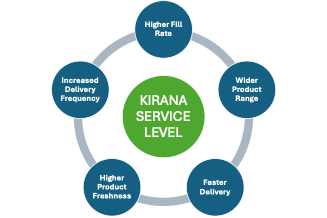
Higher Fill Rate: Ensuring maximum availability of products requested by the store.
Wider Product Range: Offering a broader selection of products to meet diverse consumer needs.
Faster Delivery: Reducing the order-to-delivery time, enabling next-day or even same-day delivery.
Higher Product Freshness: Delivering goods with optimal freshness, especially perishable items.
Increased Delivery Frequency: Frequent deliveries help reduce inventory holding costs and working capital requirements for Kirana stores, allowing them to stock more SKUs and lines with freed-up capital.
B. How Does Improving Service to Kirana Stores Benefit a CPG Manufacturer?
General Trade or Unorganized trade (Kirana stores) continues to be around 80% of the sales for CPG manufacturers in India. While other channels like Modern Retail, E-Commerce, Quick commerce etc. are growing at a faster pace, Kirana channel will continue to be the dominant channel. Therefore, enhancing service levels for Kirana stores drives several advantages for consumer packaged goods (CPG) manufacturers:
Higher Sales: Improved service levels directly contribute to sales growth. For example, manufacturers that improve fill rates by 10% often see a corresponding 3-5% increase in overall sales due to better product availability.
Increased Orders and SKUs per Retailer: Enhanced service encourages retailers to place more frequent orders with more product lines per order. One study showed that retailers serviced with next-day deliveries placed 20% more orders compared to those with weekly deliveries.
Competitive Edge: Allows manufacturers to counter margin pressure from organized players and maintain better control over the retail ecosystem.
C. What are The Challenges With Current Distribution Model in Achieving Higher Service Level?
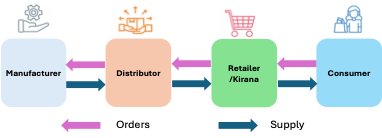
Fig: current distribution model
Limited Inventory Holding at Distributor/Stockists location: Distributors often maintain limited inventory to minimize holding costs, which restricts the variety and quantity of products available for immediate delivery to Kirana stores. This results in lower fill rates and a reduced product range offered to Kirana stores, impacting their ability to meet diverse consumer demands.
Inefficient Last-Mile Delivery: Last-mile delivery systems may not be optimized, leading to longer order-to-delivery times. Delays affect the freshness of products, especially perishables and reduce customer satisfaction.
Inconsistent Delivery Frequency: Irregular delivery schedules can lead to uneven stock replenishment. Kirana stores might struggle with fluctuating inventory levels, affecting their ability to meet consumer demand.
Lack of Technology and High Dependency on Manual Processes: Many distributors rely on manual order processing and tracking. This increases the risk of errors, delays and inefficiencies, reducing overall service reliability.
D. What are The Alternate Distribution Models for Improving Service Levels to Kirana Stores?
There can be several alternate models to service Kirana stores but some most commonly used models are:
Direct-To-Retail model
Distributor-as-a-Cross-Dock model
Hybrid of these two models;
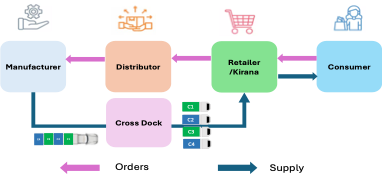
1. Direct-to-Retail Model: In this model, sales is done by distributor but delivery is done directly from manufacturers DC to retail stores directly or via a Cross-Dock location. Distributor doesn't need to hold any inventory at their place.
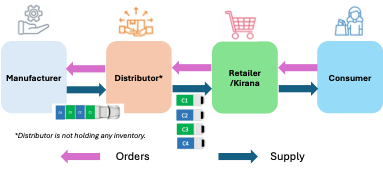
2. Distributor as Cross-Dock Model: In this model also distributor doesn't need to hold any inventory at their place. Sales is done by distributor, retail orders are picked and packed from Manufacturer DC and delivered to distributor location which acts as a cross-dock location for transfer of goods from large trucks to smaller retail delivery trucks and distributor executes the last mile delivery.
3. Hybrid Model: In this model also distributor doesn't need to hold any inventory at their place. Sales is done by distributor, retail orders are picked and packed from manufacturer DC and delivered to distributor location which acts as a cross-dock location for transfer of goods from large trucks to smaller retail delivery trucks and distributor executes the last mile delivery.
E. What Roles Traditional Distributors Will Play in Alternate Distribution Models?
Distributors currently fulfil four primary functions
Sales
Inventory Management
Last Mile Delivery
Credit and Collection
In the above proposed distribution models, inventory management shifts to CPG manufacturers, distributor doesn't hold any inventory.
Their roles may adapt based on the distribution model:
Sales and Credit/Collection Only: In some models, distributors focus on sales and financial operations.
Sales, Last Mile Delivery and Credit/Collection: In others, they may retain responsibilities for delivery along with sales and credit management.
F. What Interventions are Needed to Achieve Higher Service Levels?
Achieving elevated service levels for Kirana stores requires a combination of structural design and operational capability interventions. These steps ensure the right distribution model is in place, inventory is efficiently pooled and operational processes are optimized for speed and accuracy.
F.1. Structural Network Design Interventions
Distribution Model Finalization:
Objective: Select the ideal distribution model for each market segment, balancing cost and service efficiency. Evaluate various models (centralized vs. decentralized) and develop a Return on Investment (ROI) framework for distributors in the future scenario.
Action Steps: Analyze market characteristics, customer demand patterns, and distributor capabilities. Model different distribution scenarios to identify the most efficient structure
Inventory Pooling:
Objective: Improve inventory efficiency through centralized or decentralized pooling hubs. Inventory pooling helps to consolidate stock and reduce holding costs while enhancing service levels.
Example Impact: A company that set up inventory pooling hubs in South India saw a 15% increase in fill rates and an 18% increase in the number of order lines per order within three months.
Action Steps: Design pooling hubs based on demand forecasts, geographic considerations and existing logistics networks. Implement advanced inventory management systems to support real-time visibility and allocation.
F.2. Operational Capability Interventions
Retail Order Management Capability:
Objective: Develop systems that can manage and fulfill retail orders directly from pooled inventory locations, bypassing intermediate steps that add complexity and delay
Action Steps: Invest in Order Management Systems (OMS) that integrate seamlessly with inventory systems, enabling direct allocation of Kirana store orders against pooled inventory. Ensure the system supports real-time order tracking and dynamic allocation.
Improving Delivery Speed with Faster Picking and Packing:
Objective: Streamline warehouse operations to reduce order preparation times, enhancing the overall speed of delivery. Picking can happen at retail order level or last mile vehicle level to ensure transfer speed from mid mile to last mile vehicles.
Action Steps: Implement warehouse management systems (WMS) that optimizes picking speed, supports barcode scanning, light guided picking and sorting.
Enhanced Transportation Speed:
Objective: Optimize transportation logistics for both primary outbound and last-mile delivery to ensure quicker service to Kirana stores.
Example Impact: In Bangalore, a route optimization algorithm reduced delivery times by 35%, enabling two delivery cycles per day.
Action Steps: Deploy transportation management systems (TMS) with support for last mile route optimization features and mid mile optimization feature. Use real-time traffic data and predictive analytics to plan delivery routes efficiently.
Conclusion
These Structural and operational interventions are crucial to boosting service levels for Kirana stores. By selecting the right distribution model, optimizing inventory pooling and enhancing operational capabilities, companies can ensure faster, more reliable service, leading to improved customer satisfaction and competitive advantage.
Frequently Asked Questions
What does service level mean for kirana stores?
For a kirana store, service level covers five things: fill rate (getting the products it ordered), product range, order-to-delivery time, product freshness and delivery frequency. More frequent deliveries let a store hold less stock and use the freed-up working capital to carry more SKUs.
Why do kirana stores matter so much to CPG manufacturers in India?
General trade, made up largely of kirana stores, still accounts for around 80% of CPG sales in India. Modern retail, e-commerce and quick commerce are growing faster, but kirana remains the dominant channel, so service improvements there have the biggest effect on sales.
What is the difference between the direct-to-retail and distributor-as-cross-dock models?
In both models the distributor holds no inventory and still makes the sale. In direct-to-retail, orders are delivered from the manufacturer's DC straight to stores or via a cross-dock. In distributor-as-cross-dock, orders are picked and packed at the manufacturer's DC, transferred to smaller vehicles at the distributor's location, and the distributor handles last-mile delivery.
What role do distributors play if they no longer hold inventory?
Inventory management moves to the manufacturer. Depending on the model, distributors either focus on sales and credit and collection, or keep last-mile delivery alongside sales and credit.
Which systems are needed to raise service levels to kirana stores?
An order management system (OMS) to allocate store orders against pooled inventory, a warehouse management system (WMS) for fast, accurate picking and packing, and a transport management system (TMS) with mid-mile and last-mile route optimisation.
We use cookies and similar technologies to help personalise content, tailor and measure ads, and provide a better experience. By clicking OK or turning an option on in Cookie Preferences, you agree to this, as outlined in our cookie Policy.
Cookies are small text that can be used by websites to make the user experience more efficient. The law states that we may store cookies on your device if they are strictly necessaryfor the operation of this site. For all other types of cookies, we need your permission. This site uses various types of cookies. Some cookies are placed by third party services that appear on our pages.
Thank you! Your submission has been received!
Oops! Something went wrong while submitting the form.

.jpg)
.png)