SBX WOS · Warehouse Orchestration System

Orchestrate Everything That Moves Inside Your Warehouse — in Real Time

Stackbox WOS thinks, plans, and executes across every operator, MHE, robot, and automation asset — simultaneously, continuously, and without waiting for a supervisor’s next radio call.

A system that doesn't just track. It thinks.

Warehouse orchestration is the missing layer between your WMS and your automation hardware.

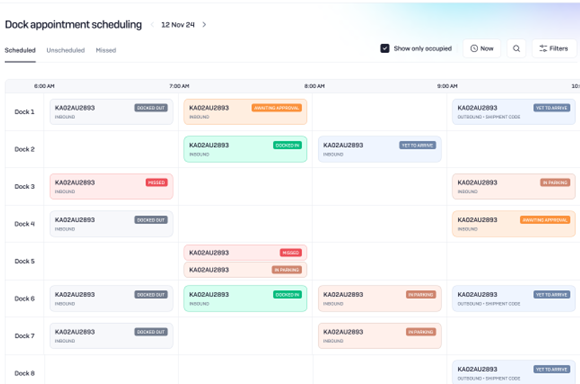
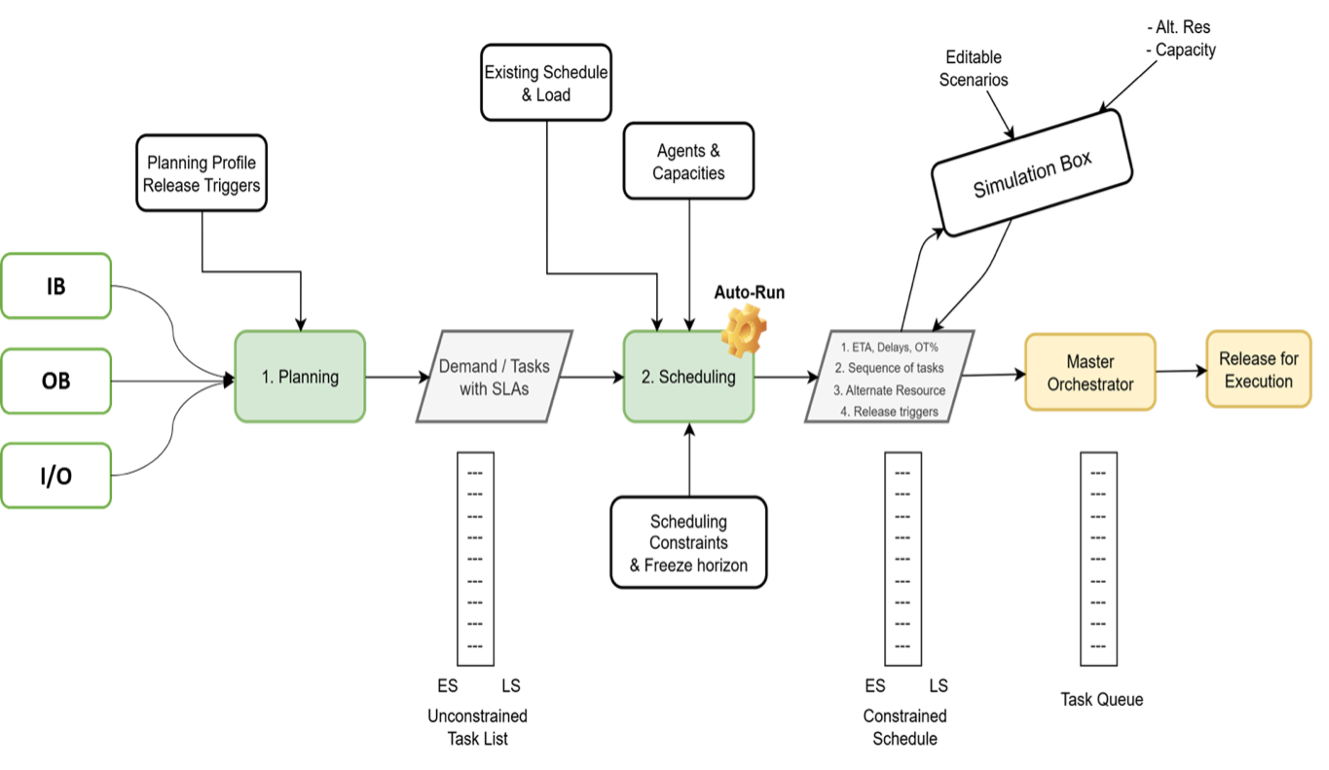
Traditional warehouse management systems track inventory and record transactions. Warehouse control systems direct individual machines. But neither was built to coordinate the full operational reality of a modern mechanized distribution center — where dozens of MHE operators, AMRs, AGVs, reach trucks, and fixed automation make thousands of interdependent decisions every hour. The result is predictable: aisle conflicts, pick starvation, MHE type mismatches, dock coordination failures, and supervisors spending every shift firefighting rather than managing. These are not equipment problems or people problems. They are orchestration problems. Stackbox WOS is the real-time orchestration layer that sits above your existing WMS — continuously answering four questions across every shift: What needs to be done right now? Who — operator and MHE — should do it? In what sequence? And how should the plan adapt when conditions change?
Stackbox content display graphic
Stackbox content frame

Mobile Automation

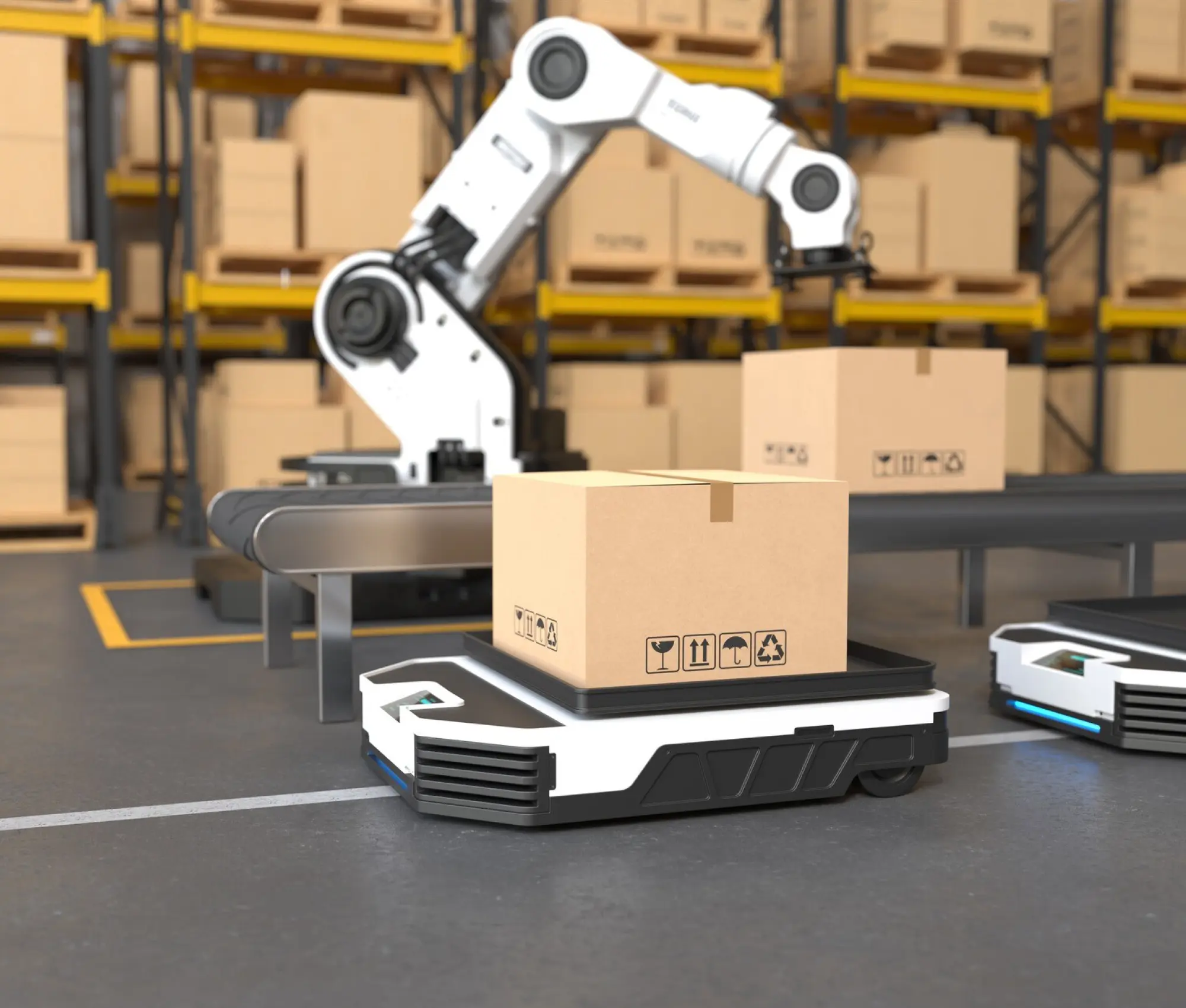
Coordinate and control fleets of AMRs, AGVs, and shuttles across zones, tasks, and vendors — with unified task dispatch and real-time reoptimization.
Stackbox content frame

Fixed Automation

Orchestrate ASRS, conveyors, and palletizers — with the ability to make over 1.5 million decisions per second.
Stackbox content frame

Predictive Decisioning

Powered by Oswald, anticipate delays, congestion, and exceptions — and act before they happen.
Office setting

Material Graph Simulation

Visualize, simulate, and predict material flow through complex warehouse paths — before it happens.
Office setting

Unified Navigation Engine

Harmonize SLAM maps from all mobile vendors into a single global spatial language for true fleet interoperability.
Office setting

Intelligent Routing

Adaptively reroute assets, bots, and tasks to avoid congestion, downtime, and workflow collisions.
Office setting

Human Workforce

Assign, guide, and optimize human task flows in real time with skill-based logic and SOP enforcement
How Stackbox WOS Works

A persistent real-time orchestration layer between your WMS and your physical warehouse operation.

Planning & Optimization

Order & Wave Planning
Segments and sequences orders into optimized batches or waves considering dock capacity, cutoffs, and order mix
Containerization & Packing Logic
Determines quantity and type of containers (e.g., crates, totes, cartons) required for efficient dispatch or staging.
Material Flow Determination
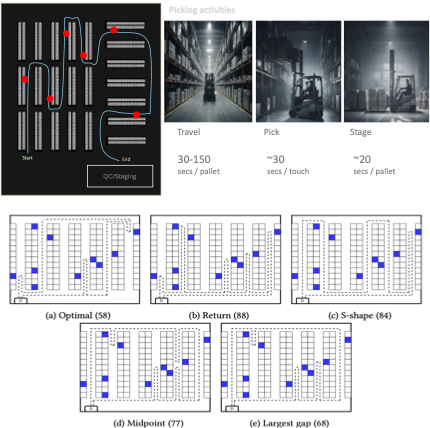
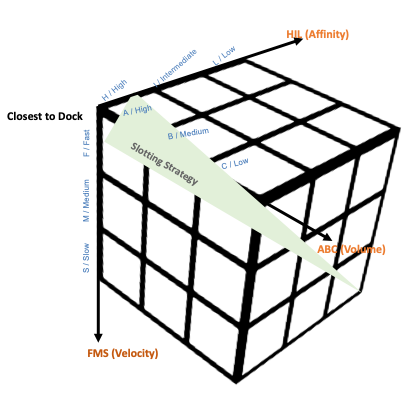
Determines the most efficient execution path for orders, SKUs, and workloads based on velocity, SLA, and resource profiles
Resource Planning
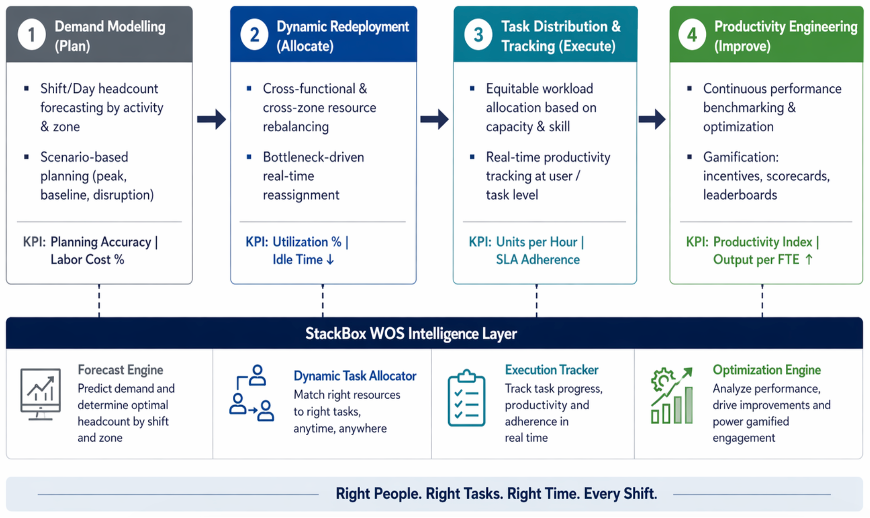
Predicts required equipment, stations, manpower capacity for planned wave
Station & Zone Allocation
Optimally maps workload to execution zones, equipment, or GTP stations to balance utilization
Simulation & Scenario Planning
Enables “what-if” modeling of workload distribution, resource changes, or fulfillment constraints.
Stackbox client project showcase

Multi Agent Orchestration

Task Granularization
Breaks high-level workflows into micro-tasks tailored to specific executor types (e.g., picker, AMR, sorter).
Dynamic Task Allocation
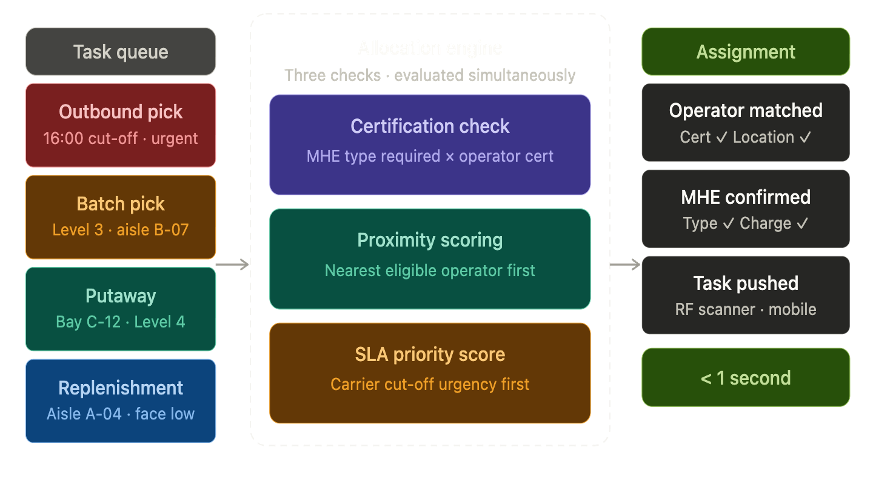
Assigns and sequences tasks based on real-time factors like proximity, priority, skill level, or equipment availability.
Unified task dispatcher
for AMRs, AGVs, AS/RS, conveyors, forklifts, and human operators including cross-agent collaboration and dynamic handoffs between automation layers
Workload Balancing
Distributes tasks intelligently across resources and zones to avoid congestion or idle time.
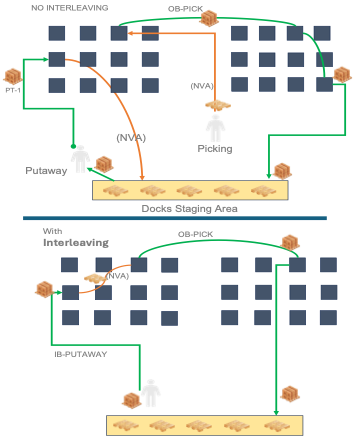
Task Interleaving
Combines compatible workflows to reduce redundant travel or touchpoints.
Real-Time Reprioritization
Adjusts task queues dynamically in response to SLA risk, system events, or exceptions
Exception Handling & Auto-Recovery
Detects failures, delays, or skips and reroutes or reassigns tasks without manual intervention.
Stackbox implementation process step 11

Interoperability

Hardware Abstraction Layer (HAL)
Standardizes communication with automation equipment (e.g., AMRs, ASRS, conveyors, PTL, robotics).
Protocol Flexibility
Supports REST, MQTT, OPC-UA, TCP/IP, andcustom OEM integrations
Multi-Agent Synchronization
Enables real-time coordination between humans and machines as a single execution mesh.
Device-Aware Routing
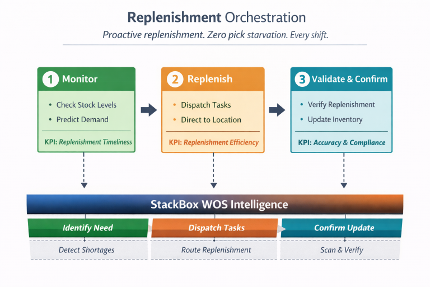
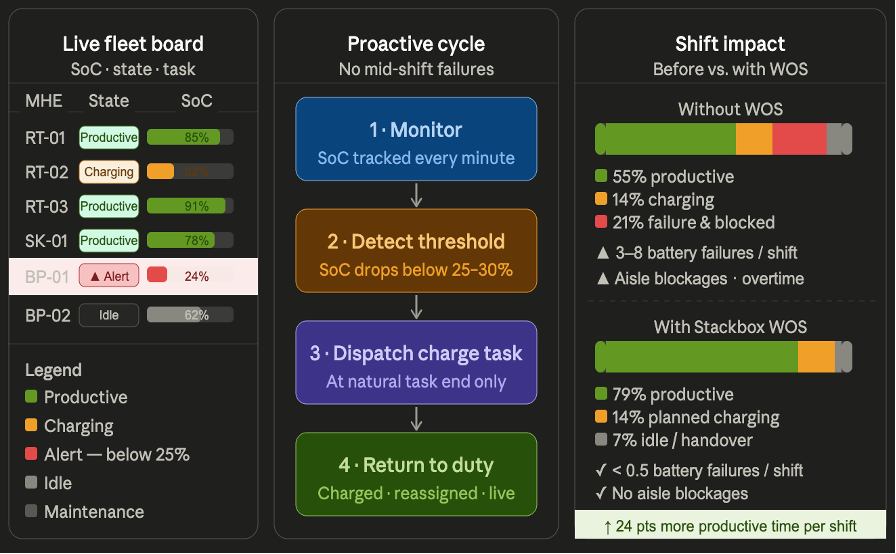
Sends optimized task instructions based on each device’s constraints and state (e.g., charge, load, queue)
Fleet-Agnostic Support
Works with multiple vendors or mixed fleets within a single site or across sites.
Stackbox creative work sample

Integration

ERP/OMS/TMS Integration
Syncs inventory, order, and shipment data bi-directionally with SAP, Oracle, NetSuite, Dynamics, and others.
Event-Driven Architecture
Enables responsive, low-latency system behavior via webhooks and message queues.
Data Normalization & Reconciliation
Ensures accurate alignment between physical operations and digital records
API Gateway & SDKs
Provides standard and extensible APIs for customer-specific integrations and partner ecosystems
External Visibility Readiness
Supports integration with control towers, analytics layers, and digital twin platforms.
Stackbox implementation process step 23
Why Stackbox WOS

Stackbox WOS is purpose-built for the complexity that WMS, WCS, and WES platforms were not designed to handle.

Design-Aware Execution

WOS closes the loop between facility design, daily planning, and task execution — continuously. It tracks a real-time design compliance score and triggers reslotting when throughput begins to degrade.

Vendor-Agnostic by Architecture

Integrate any AMR, AGV, MHE, or automation OEM without rearchitecting your stack. WOS becomes the stable orchestration layer as your hardware evolves beneath it.

Proactive, Not Reactive

In an unorchestrated DC, supervisors respond to problems after they occur. In a WOS-orchestrated DC, exceptions are detected, impact is calculated, and corrective action is recommended — in under 5 minutes, not 30–60.

Fast Implementation. Measurable Value.

Capital-efficient deployment with measurable operational outcomes — not multi-year rollouts. Stackbox customers see throughput improvement and MHE utilization gains before full go-live.

MHE-First Orchestration

WOS was built for mechanized DCs where Reach Trucks, BOPTs, HOPTs, and Stackers are the primary assets. Every task assignment checks MHE type, certification, battery state, and current location before dispatch.

Augments Your Existing WMS

Stackbox WOS integrates with SAP, Oracle, Manhattan, and all major WMS platforms. There is no rip-and-replace. WOS becomes the orchestration intelligence layer above your existing warehouse software.

Planning & Optimization

Order & Wave Planning
Segments and sequences orders into optimized batches or waves considering dock capacity, cutoffs, and order mix
Containerization & Packing Logic
Determines quantity and type of containers (e.g., crates, totes, cartons) required for efficient dispatch or staging.
Material Flow Determination
Determines the most efficient execution path for orders, SKUs, and workloads based on velocity, SLA, and resource profiles
Resource Planning
Predicts required equipment, stations, manpower capacity for planned wave
Station & Zone Allocation
Optimally maps workload to execution zones, equipment, or GTP stations to balance utilization
Simulation & Scenario Planning
Enables “what-if” modeling of workload distribution, resource changes, or fulfillment constraints.
Stackbox UI design portfolio for logistics software
Stackbox UX design case study for warehouse operations
Stackbox client project showcase
Stackbox design portfolio piece

Multi Agent Orchestration

Task Granularization
Breaks high-level workflows into micro-tasks tailored to specific executor types (e.g., picker, AMR, sorter).
Dynamic Task Allocation
Assigns and sequences tasks based on real-time factors like proximity, priority, skill level, or equipment availability.
Unified task dispatcher
for AMRs, AGVs, AS/RS, conveyors, forklifts, and human operators including cross-agent collaboration and dynamic handoffs between automation layers
Workload Balancing
Distributes tasks intelligently across resources and zones to avoid congestion or idle time.
Task Interleaving
Combines compatible workflows to reduce redundant travel or touchpoints.
Real-Time Reprioritization
Adjusts task queues dynamically in response to SLA risk, system events, or exceptions
Exception Handling & Auto-Recovery
Detects failures, delays, or skips and reroutes or reassigns tasks without manual intervention.

Interoperability

Hardware Abstraction Layer (HAL)
Standardizes communication with automation equipment (e.g., AMRs, ASRS, conveyors, PTL, robotics).
Protocol Flexibility
Supports REST, MQTT, OPC-UA, TCP/IP, andcustom OEM integrations
Multi-Agent Synchronization
Enables real-time coordination between humans and machines as a single execution mesh.
Device-Aware Routing
Sends optimized task instructions based on each device’s constraints and state (e.g., charge, load, queue)
Fleet-Agnostic Support
Works with multiple vendors or mixed fleets within a single site or across sites.
Stackbox client project sample
Stackbox client project showcase
Stackbox implementation process step 23
Stackbox supply chain app user interface design

Integration

ERP/OMS/TMS Integration
Syncs inventory, order, and shipment data bi-directionally with SAP, Oracle, NetSuite, Dynamics, and others.
Event-Driven Architecture
Enables responsive, low-latency system behavior via webhooks and message queues.
Data Normalization & Reconciliation
Ensures accurate alignment between physical operations and digital records
API Gateway & SDKs
Provides standard and extensible APIs for customer-specific integrations and partner ecosystems
External Visibility Readiness
Supports integration with control towers, analytics layers, and digital twin platforms.
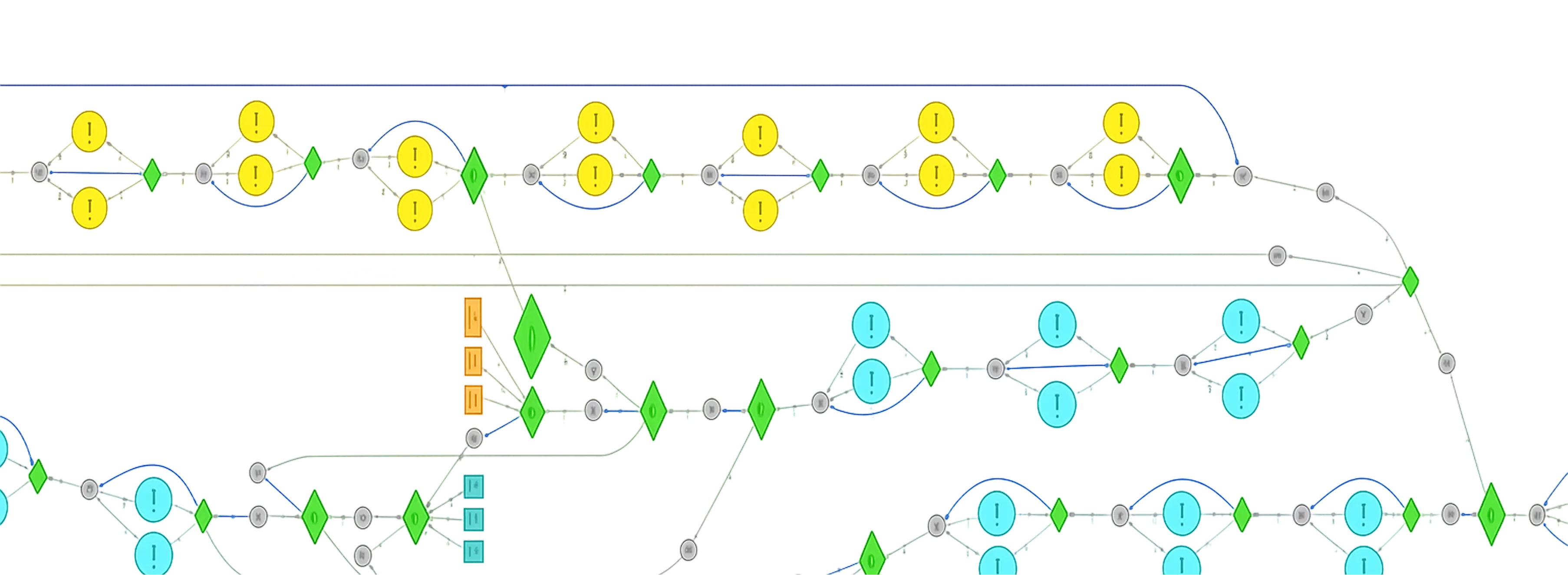
The Material Graph

A real-time graph of every material movement, handoff, and decision node — from goods receiving to dispatch.

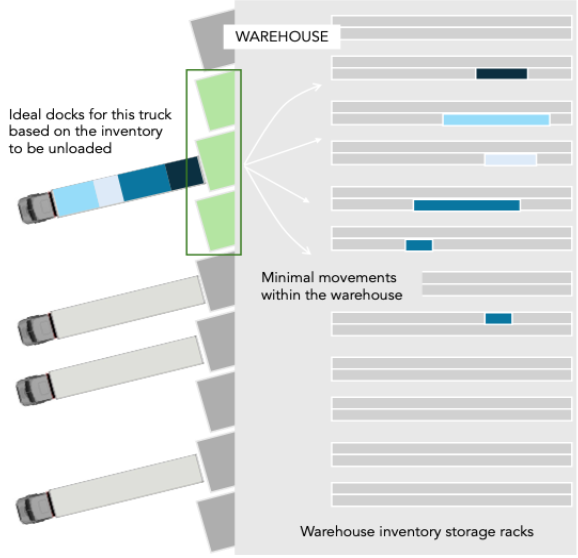
From the moment a carrier books an appointment to the moment the last outbound trailer departs, Stackbox WOS models every task, handoff, delay point, and decision node in your facility. This material graph is the operational intelligence that enables predictive intervention before bottlenecks compound across the shift, system-wide optimization across inbound, storage, and outbound flows simultaneously, seamless integration of new automation assets without operational disruption, and digital simulation of layout changes, slotting strategies, and flow configurations before implementation.
Stackbox content display

Stackbox WOS manages fixed automation, mobile robot fleets, and human workforces under a single orchestration layer — with no vendor lock-in.

Fixed Automation — AS/RS, Conveyors, Sorters, Palletizers

Green checkmark icon
Orchestrates thousands of micro-decisions per second to maintain flow continuity
Green checkmark icon
Interfaces with PLC and OEM WCS layers to issue live commands
Green checkmark icon
Monitors asset health, cycle times, and congestion across zones
Green checkmark icon
Syncs upstream/downstream systems to avoid overloading
Green checkmark icon
Supports capacity-aware buffering and zone prioritization
Green checkmark icon
Enables integration of multiple fixed systems as a cohesive network

Mobile Automation — AMRs, AGVs, Reach Trucks, Stackers, BOPTs, HOPTs

Green checkmark icon
Unified fleet management across multi-vendor AMRs and AGVs
Green checkmark icon
Real-time task assignment based on location, battery, load, and traffic
Green checkmark icon
Intelligent routing with dynamic path replanning
Green checkmark icon
Cross-zone coordination with human and fixed assets
Green checkmark icon
Unified navigation map that harmonizes diverse SLAM schemas
Green checkmark icon
Interoperability layer for mixed OEM coordination under one logic
Stackbox client project sample

Human Workforce

Green checkmark icon
Skill-based task assignment and SOP guidance
Green checkmark icon
Real-time collaboration with bots and machines via mobile apps
Green checkmark icon
Supports interleaved workflows
Green checkmark icon
Task escalation and exception handling built-in
Green checkmark icon
Tracks fatigue, overutilization, and performance insights
Green checkmark icon
Contextual nudges and adaptive task queues for continuous efficiency
Stackbox client project showcase

Unified navigation layer

A Unified Navigation Engine that seamlessly augments, translates, and overlays navigation schemas from multiple mobile automation vendors — unifying them into a single global warehouse map.

Whether you're running AMRs, AGVs, or mobile pickers from different OEMs, Stackbox WOS eliminates silos by:

•  Interprets SLAM/local maps into a shared spatial language
• Enables cross-vendor coordination
• Visualizes all movement in real time
• Supporting dynamic updates as new zones, racks, or routes are introduced
Stackbox platform feature showcase
Stackbox implementation process step 23

Your warehouse mission control

Real-time visibility + AI-powered foresight.
Green checkmark icon
Live dashboards for asset health, task progress, and exceptions
Green checkmark icon
Alerts, cycle-time trends, predictive congestion, and fatigue detection
Green checkmark icon
Decision override capabilities and escalation workflows
Green checkmark icon
Powered by Oswald, the AI engine that learns, adapts, and optimizes over time
Testimonials

Loved by our clients

Stackbox monogram

The Stackbox implementation has transformed our warehouse management processes. The user-friendly interface and powerful integrations have significantly reduced manual efforts, enabling our team to focus on optimizing overall supply chain performance.

John

Chief Product officer

Stackbox monogram

Stackbox’s solution has been a game-changer for our transport management. The ease of integration and the intuitive design have simplified complex operations, saving us time and improving accuracy across the board.

Arpit

Director of Supply Chain

Stackbox monogram

Stackbox's delivery application has revolutionized our last-mile delivery process. The seamless coordination between our warehouse and stores ensures timely deliveries, reducing delays and enhancing customer satisfaction. It's a robust solution that has streamlined our entire delivery operation.

Cristina

Director of Supply chain

Testimonials

Stackbox WOS transformed how we coordinate dock operations and MHE fleets. Our dock-to-stock time dropped by over 50% in the first quarter of deployment and our supervisors now manage by exception, not by radio.

Procter and Gamble logo
Head of Supply Chain Operations
Head of distribution, Mumbai
Testimonials

The real-time orchestration WOS provides was the missing piece in our DC. Pick travel is down 35%, MHE utilization is up significantly, and our aisle conflict rate is essentially zero since go-live.

Procter and Gamble logo
VP Warehouse Operations
Retail DC Operations, India
Testimonials

WOS integrated with our existing SAP environment without any rip-and-replace. We saw measurable throughput improvement within weeks, and the automated battery rotation has practically eliminated mid-shift MHE failures.

Procter and Gamble logo
Director, Distribution & Logistics
3PL Operations, Southeast Asia
FAQS

Frequently Asked Questions

Want to know more? Email us at contact@stackbox.co.in
Get in touch
What is a Warehouse Orchestration System (WOS)?
A Warehouse Orchestration System (WOS) is an AI-powered software platform that thinks and acts in real time — continuously coordinating every operator, MHE, mobile robot (AMR/AGV), and fixed automation asset across a distribution center in real time. Unlike a warehouse management system (WMS) that tracks inventory, or a WCS/WES that controls individual machines, a WOS acts as the decision-making intelligence above both — continuously planning, executing, and adapting every task, resource, and route decision across the full shift.
How is Stackbox WOS different from a WMS or WES?
A WMS manages inventory and records warehouse transactions. A WES (Warehouse Execution System) translates WMS instructions into machine-level control. A WOS operates above both — continuously orchestrating every asset, task, and flow across the entire facility, including human operators and MHE fleets. The key distinction is real-time adaptability: WMS and WES systems are largely static and reactive. Stackbox WOS reoptimizes continuously, detecting exceptions and recommending corrective action in under 5 minutes.
Does Stackbox WOS replace my existing WMS?
No. Stackbox WOS integrates with and augments your existing warehouse management system — whether SAP, Oracle, Manhattan, or any other WMS platform. WOS adds an intelligent orchestration layer above your existing WMS without requiring a rip-and-replace. Most implementations go live with measurable operational improvements before the full WOS feature set is deployed.
Is Stackbox WOS suitable for FMCG and 3PL warehouses in India?
Yes. Stackbox WOS was purpose-built for the operational complexity of high-throughput FMCG, 3PL, and retail distribution centers. It is deployed across India and Southeast Asia with customers including Nestlé, P&G, Walmart, Unilever, and Coca-Cola. The platform handles the full range of mechanized DC environments — multi-tier racking, mixed MHE fleets, high SKU velocity, and omnichannel order profiles — that characterize FMCG and 3PL operations in India.