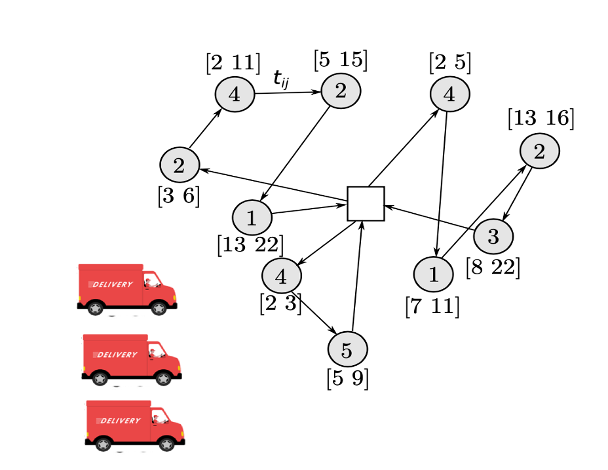
In today's fast-paced customer service landscape, businesses face mounting challenges — including rising fuel costs, delivery delays and inefficient fleet utilization. Vehicle route optimization is no longer optional — it's essential for companies looking to maintain a competitive edge. As a core challenge in logistics and transportation, optimizing vehicle routes impacts businesses that depend on seamless deliveries, timely pickups and effective fleet management. The field of Operations Research (OR) provides the mathematical foundation for solving these complex routing problems, which are often described using acronyms such as:
TSP (Traveling Salesman Problem)
VRP (Vehicle Routing Problem)
CVRP (Capacitated VRP)
HFVRP (Heterogeneous fleet VRP)
PDVRP (Pickup and Delivery VRP)
CVRPTW (Capacitated Time Window VRP)
These models define how routes should be planned based on business constraints such as distance, capacity, pickup/delivery sequencing and time windows.
A. Key Routing Models and Constraints
A.1. Traveling Salesman Problem (TSP)
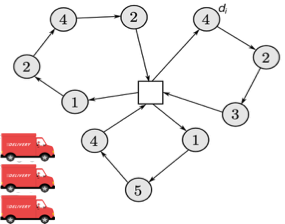
The TSP is one of the simplest routing problems. It involves finding the shortest possible route for a single vehicle to visit a set of locations before returning to its starting point. In modern optimization platforms like StackBox, the TSP is referred to as a "Vehicle model," where:
The vehicle has a start and end location.
The sequence of stops is optimized to minimize the total travel distance.
Distance and travel time calculations are based on geographical coordinates using the actual road distance and traffic speed.
A.2. Vehicle Routing Problem (VRP)
The VRP extends the TSP by considering multiple vehicles and the need to distribute deliveries efficiently among them. VRP models help businesses optimize fleet operations by:
Assigning delivery requests to the most suitable vehicle.
Minimizing overall travel distance and fuel consumption.
Ensuring balanced workloads across vehicles.
A.3. Capacitated Vehicle Routing Problem (CVRP)
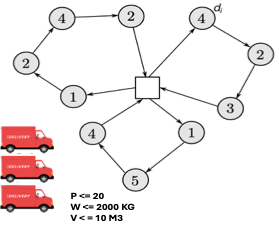
This model involves a fleet of identical vehicles with a fixed capacity. Capacity constraints ensure that a vehicle does not exceed its carrying limit while minimizing total cost. In a delivery network:
Each vehicle has a maximum number of deliveries (P) /maximum weight (W) /maximum volume (V) it can carry.
Overloading a vehicle is prevented by optimizing assignments accordingly.
A.4. Heterogeneous Fleet VRP (HFVRP):
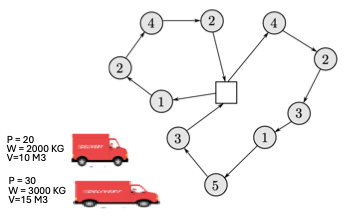
This model is similar to CVRP except this model considers fleets composed of different types of vehicles, each with varying capacities and costs. Utilizing a heterogeneous fleet can lead to significant cost savings in many practical applications.
A.5. Pickup and Delivery Sequencing (PDVRP):
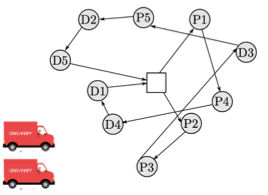
This model focuses on scenarios where items must be picked up from specific locations and delivered to others. Each pickup and delivery pair is linked and routes must be planned to respect these dependencies.
Pickup and delivery constraints enforce logical order in routes. For example:
A courier cannot deliver a package before picking it up.
Restaurant food deliveries must ensure that pickup occurs before customer delivery.
A.6.Capacitated Time Window VRP (CVRPTW)
This variant adds time constraints to the CVRP. Each customer must be serviced within a specific time window and vehicles may wait if they arrive early. The goal remains to minimize total cost while adhering to both capacity and time constraints.
Time windows define the allowable time range for arrivals at each location.
Reducing failed delivery attempts.
Ensuring deliveries occur when the recipient is available.
Synchronizing fleet schedules with customer expectations.
A.7. Other Variants:
Multi Compartment Routing: A Multi-Compartment Vehicle Routing Problem (MCVRP) that aims to plan the delivery of different products to a set of geographically dispersed customers. It is applicable in many industries e.g. QSR industry where truck has dry, frozen and/or chilled compartments.
Electric Vehicle Routing: Addresses the challenges associated with electric vehicles, such as limited range and the need for recharging at specific locations.
Dynamic Re-Routing: Considers real-time changes like traffic conditions or new customer requests, allowing for route adjustments on-the-fly.
AMR Routing : Intralogistics use case like autonomous vehicle routing within a facility.
B. VRP Optimization in Practice: StackBox Approach
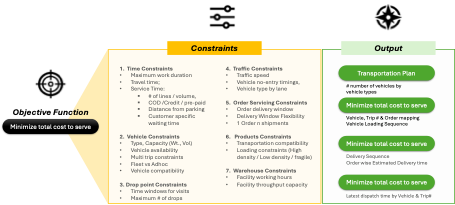
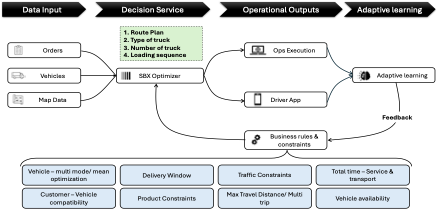
StackBox advanced VRP optimizer allows users to configure a large number of real world constraints like capacity, cost, availability, exclusive zone, pickup/delivery rules and time windows to ensure that plan output is the most practical and feasible from an execution perspective.
Objective Function:
The primary objective of the StackBox VRP optimizer is to minimize the total cost to serve while ensuring adherence to service level commitments. This is achieved through:
Reducing total travel time by optimizing routes dynamically based on real-time traffic conditions.
Minimizing the number of vehicles required while ensuring timely delivery windows are met.
Optimizing fleet utilization by balancing loads across vehicles and reducing empty return trips.
Enhancing customer satisfaction by ensuring on-time deliveries within the required constraints.
Key Constraints Considered in Optimization
1. Time Constraints
Maximum work duration per driver.
Travel time between stops.
Service time per delivery (based on number of lines, volume, cash on delivery, etc.).
Distance from the parking area to the delivery location.
Customer-specific waiting time requirements.
2. Vehicle Constraints
Vehicle type and capacity (weight, volume and number of handling units limitation).
Multi-trip constraints for return and additional deliveries.
Compatibility between specific customer requirement and vehicle types.
Multi compartment constraints e.g. Dry and Frozen.
Fixed and variable costs for vehicles.
Max distance covered by a vehicle e.g. Electric Vehicles.
Vehicle service zone constraints due to permit requirement etc.
3. Drop Point Constraints
Defined time windows for delivery visit.
Maximum number of drop points per route to maintain efficiency.
4. Traffic Constraints
Real-time and historical traffic speed data for route planning.
No-entry time restrictions for certain vehicle types in urban areas.
Vehicle-type-specific lane access constraints.
5. Order Servicing Constraints
Delivery window commitments for different customers and orders.
Planning at Customer vs Order vs Line vs Line Split level.
Flexibility in order batching to optimize multi-shipment fulfillment.
6. Product Constraints
Transportation compatibility based on product sensitivity (e.g., fragile, perishable, high-density, low-density items).
Loading constraints for balancing vehicle weight distribution.
Throughput capacity of distribution centers to prevent bottlenecks
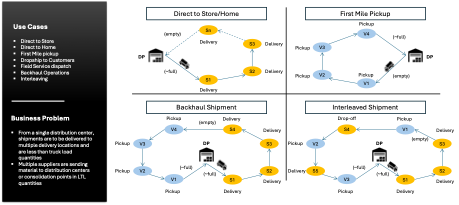
StackBox Vehicle Route Optimization Deployed in Real-World Scenarios:
1. Direct to Store Deliveries
Optimized delivery routes for retailers receiving shipments directly from distribution center.
2. Direct to Home Deliveries
Efficient home delivery planning for E-commerce shipments with real-time tracking and customer notifications.
Supports cash on delivery, contactless delivery and multi-attempt strategies for failed deliveries.
3. First Mile Pickup Optimization
Streamlined pickup operations from suppliers, warehouses or collection hubs.
Reduces empty miles and ensures smooth inbound logistics for further distribution
4. Drop-Shipping to End Customers (Multiple Dependent Picks & Drops)
Enables direct order fulfillment from suppliers to end customers without intermediate storage.
Optimizes multi-stop routes with dependency handling for interlinked deliveries.
5. Field Service Dispatch Optimization
Ensures efficient routing of field service personnel for maintenance, repairs or installations.
Reduces service response time and optimizes technician workload allocation.
6. Backhaul Operations
Utilizes return trips effectively by assigning pickup loads on the way back.
Reduces transportation costs and optimizes vehicle utilization.
7. Interleaving (Multiple Independent Picks and Drops)
Intelligent sequencing of multiple independent pickups and drop-offs.
Optimizes fleet efficiency by reducing empty trips and balancing route loads.
Conclusion
StackBox's Vehicle Routing Optimization is built to address the growing complexities of last-mile logistics. With cutting-edge technology, real-time optimization and data-driven decision-making - businesses can enhance delivery efficiency, reduce costs and improve customer satisfaction. Our commitment to innovation ensures that logistics operations remain agile and competitive in a rapidly evolving market.
"Businesses that adopt advanced route optimization can achieve up to 20% cost savings and 30% service level improvements."
We use cookies and similar technologies to help personalise content, tailor and measure ads, and provide a better experience. By clicking OK or turning an option on in Cookie Preferences, you agree to this, as outlined in our cookie Policy.
Cookies are small text that can be used by websites to make the user experience more efficient. The law states that we may store cookies on your device if they are strictly necessaryfor the operation of this site. For all other types of cookies, we need your permission. This site uses various types of cookies. Some cookies are placed by third party services that appear on our pages.
Thank you! Your submission has been received!
Oops! Something went wrong while submitting the form.

.jpg)