
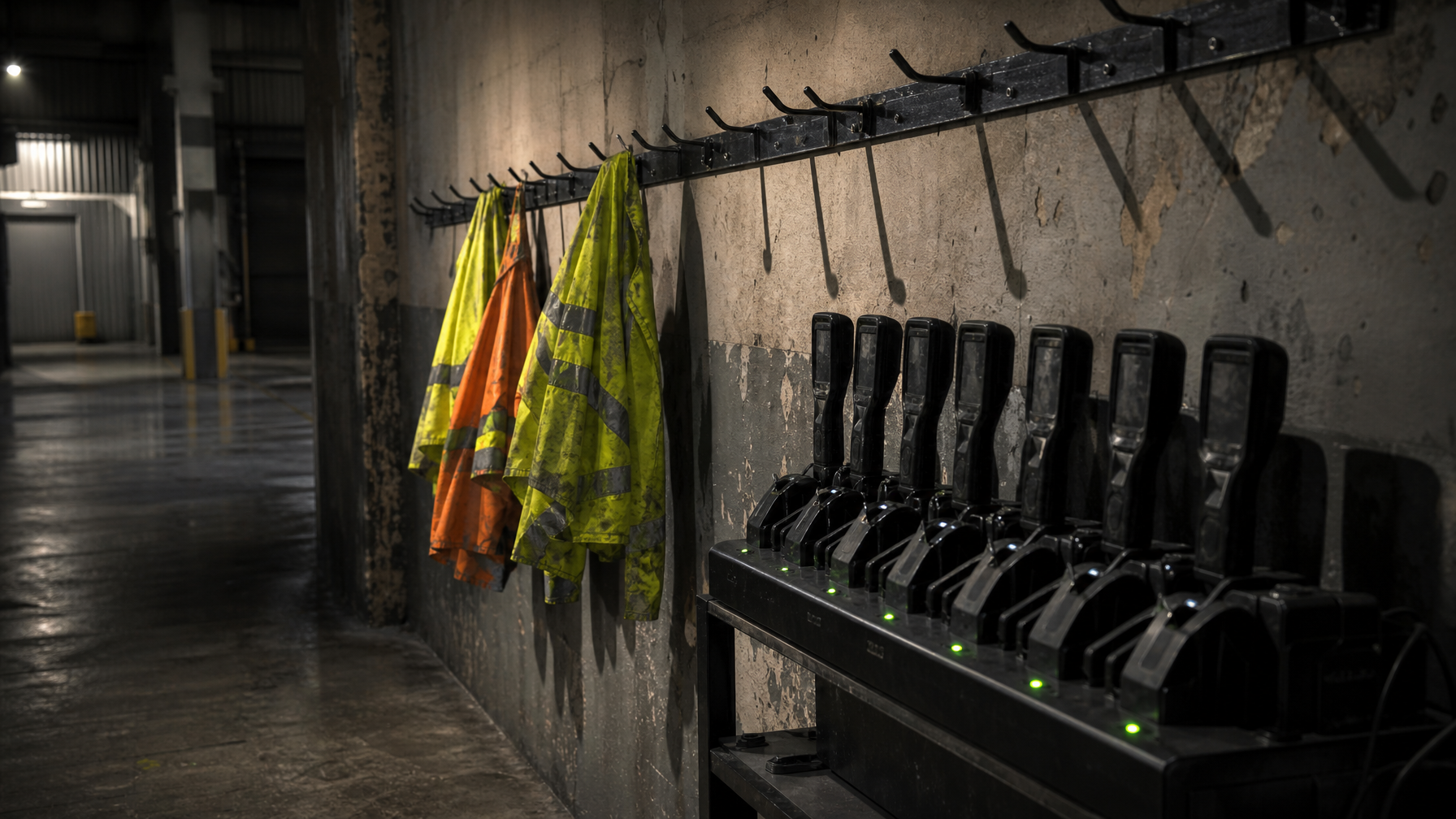
Warehouse automation in India has always been positioned as a future investment. Something to plan for when volumes justify it, when budgets allow, when the operation matures. But the labour reality in Indian warehousing has shifted faster than most supply chain leaders expected, and the economics that made cheap labour an alternative to automation are eroding quarter by quarter.
The numbers tell the story. Warehouse worker attrition in Indian metros runs at 60-80% annually. The gig economy and quick-commerce delivery have created competing demand for the same labour pool, pushing wages up 15-25% over the past three years in tier-1 cities. Seasonal surges (Diwali, year-end sales, monsoon stockpiling) create temporary shortages that no staffing agency can reliably fill. And the workers who do stay require constant retraining because the ones who leave take their process knowledge with them.
This is not a labour shortage that can be solved by paying more. It is a structural shift that requires a fundamentally different approach to how warehouse work gets done.
India's quick-commerce boom (Blinkit, Zepto, Swiggy Instamart) has created a parallel labour market that directly competes with traditional warehousing for the same workers. A delivery rider for a quick-commerce platform earns ₹18,000-25,000 per month with flexible hours, outdoor work, and daily payment options. A warehouse floor worker earns ₹15,000-20,000 per month with fixed shifts, physically demanding indoor work, and monthly salary cycles.
For a 22-year-old in Bangalore or Pune, the choice is straightforward. The quick-commerce job offers comparable or better pay, more autonomy, and the social status of working for a recognisable consumer brand. The warehouse job offers none of these advantages. This is not a temporary labour diversion. Quick commerce is growing at 40-50% annually, and its labour demand is growing with it.
Warehouse wages in Indian metros have risen 15-25% over the past three years, driven by competition from gig platforms, minimum wage revisions, and the shrinking pool of workers willing to take warehouse jobs. For a warehouse with 100 floor workers, a 20% wage increase translates to an additional ₹30-40 lakh per year in labour costs.
This wage increase would be sustainable if productivity had kept pace. But most Indian warehouses are still operating with the same manual processes, the same paper-based workflows, and the same supervisor-dependent task assignment they used five years ago. Productivity per worker has remained flat while the cost of that worker has risen. The gap between what you pay and what you get is widening every year.
When annual attrition is 60-80%, a warehouse with 100 workers replaces 60-80 of them every year. Each replacement requires 2-4 weeks of training before the new worker reaches full productivity. During this training period, the worker is at 50-60% productivity, making errors that require supervisor time to correct, and occupying training resources that could be deployed elsewhere.
The hidden cost is not just the training itself. It is the knowledge loss. Experienced workers know the warehouse layout intuitively, know which SKUs are in which zones, and know the shortcuts that save time on every pick path. New workers walk more, scan more, and ask more questions. In a warehouse with 80% attrition, half the floor at any given time consists of workers who have been there less than six months and are still climbing the learning curve.
| Factor | 2023 | 2026-27 | Trend |
|---|---|---|---|
| Avg warehouse wage (metros) | ₹14,000-17,000/mo | ₹18,000-24,000/mo | Rising 15-25% over 3 years |
| Annual attrition | 50-60% | 60-80% | Increasing |
| Time to full productivity | 2-3 weeks | 3-4 weeks (complexity up) | Getting longer |
| Seasonal labour gap | 15-20% unfilled | 25-35% unfilled | Worsening |
| Competing gig jobs | Limited | Blinkit, Zepto, Swiggy, etc. | Growing 40-50% YoY |
The instinctive response to a labour problem is to replace labour with machines. Automated storage and retrieval systems (AS/RS), goods-to-person robots, conveyor-based sortation: these technologies work and they reduce headcount. But they come with constraints that make them unsuitable for the majority of Indian warehouse operations.
Capital cost
A basic AS/RS installation for a 50,000 sq ft warehouse starts at ₹8-12 crore. Goods-to-person robotic systems start at ₹5-8 crore. For a brand operating 10-20 warehouses across India, the capital outlay for hardware automation across the network runs into hundreds of crores. Most Indian FMCG and retail operations cannot justify this investment given their current margins.
Flexibility constraints
Hardware automation is designed for specific throughput profiles, SKU dimensions, and order patterns. When the business changes (new product lines, different order sizes, seasonal volume swings), the automation may not adapt. Indian warehouses often handle 5,000-15,000 SKUs across multiple categories with wide variation in size, weight, and handling requirements. Rigid automation struggles with this diversity.
Infrastructure requirements
Most Indian warehouses are leased facilities in industrial areas, not purpose-built fulfilment centres. Installing conveyors, mezzanines, or robotic systems requires structural modifications that the landlord may not permit, and the brand cannot recover the investment if the lease ends. The average warehouse lease in India is 3-5 years, shorter than the payback period for most hardware automation.
The alternative to replacing workers with machines is making each worker significantly more productive through software-driven warehouse automation. This approach does not reduce headcount to zero. It reduces headcount dependency: fewer workers doing more work, with less training time, fewer errors, and less impact when someone leaves.
Task interleaving eliminates idle time
A Warehouse Orchestration System (WOS) assigns the next task before the current one is complete, eliminating the 30-40% of shift time that workers spend waiting between assignments. This is the equivalent of adding 30-40% more worker-hours without hiring anyone. Stackbox WOS reports 40% less travel across 100+ live sites.
System-directed workflows reduce training time
When the WMS tells the worker exactly where to go, what to pick, and where to put it (via RF scanner or mobile device), the worker does not need to memorise the warehouse layout. A new worker can be productive on Day 1 because the system provides step-by-step instructions. Training time drops from 3-4 weeks to 3-5 days for basic operations.
Automated slotting reduces walk distance
WMS-driven slotting places fast-moving SKUs in the most accessible locations, reducing the average pick path length. When the system continuously re-slots based on velocity changes (seasonal shifts, promotion effects), the warehouse layout adapts without manual intervention. Workers walk less to pick more.
Error reduction through scan verification
Each pick, put-away, and pack is verified by barcode or QR scan. The system rejects incorrect picks before they reach the packing station. This eliminates the 2-5% error rate typical in paper-based Indian warehouses and removes the need for secondary quality checks by experienced workers.
The pragmatic approach for Indian warehouses is to start with software-driven automation and add hardware selectively where the volume and consistency justify it.
Phase 1: WMS + WOS deployment (Month 1-3)
Implement a cloud-based WMS with task interleaving, system-directed putaway, optimised pick paths, and scan-verified operations. This delivers 25-40% productivity improvement per worker, reduces training time by 80%, and achieves 99.9% inventory accuracy. No hardware investment required beyond RF scanners or mobile devices.
Phase 2: Process automation for repetitive tasks (Month 4-6)
Add automated print-and-apply labelling, conveyor-assisted packing stations, and automated weighing/dimensioning where the volume of a single SKU category justifies it. These are targeted hardware investments (₹20-50 lakh each) that address specific bottlenecks without requiring a full warehouse redesign.
Phase 3: Selective robotic automation (Month 7-12)
For warehouses where a specific zone handles high-volume, consistent-dimension products (e-commerce picking of standard boxes, for example), introduce goods-to-person robots or autonomous mobile robots (AMRs) in that zone only. The WOS orchestrates both human workers and robots, treating them as different types of resources with different capabilities.
This staged approach keeps the initial investment under ₹50 lakh (WMS + WOS + scanners), delivers measurable productivity gains within the first quarter, and builds the data foundation for targeted hardware investments that can be justified with observed throughput and volume data rather than projections.
The labour crisis is not going to reverse. Gig economy competition will intensify as quick commerce expands to tier-2 and tier-3 cities. Wage inflation will continue as minimum wage revisions work through the system. Attrition will remain high as long as warehouse work offers less flexibility and comparable pay to delivery gig work.
A warehouse that does nothing will face increasing costs (wage inflation), decreasing reliability (attrition and seasonal shortages), and increasing quality problems (undertrained workers making more errors). The compounding effect means that the gap between an automated operation and a manual one widens every year. The brand that automates today locks in a 25-40% productivity advantage that the manual competitor cannot match by hiring.
At 100+ live sites with 40% less travel and 99.9% inventory accuracy, Stackbox WMS and WOS represent the software automation layer that makes each warehouse worker count for more, and makes the operation resilient to a labour market that will only get tighter.
Software-driven warehouse automation uses WMS and WOS systems to optimise how human workers operate, without replacing them with hardware. It includes system-directed picking (the WMS tells the worker exactly where to go), task interleaving (the WOS assigns the next task before the current one ends), automated slotting (the WMS places products in optimal locations), and scan-verified operations (barcodes confirm every action). The result is 25-40% higher throughput per worker without capital investment in robots or conveyors.
In a system-directed warehouse, the worker's mobile device or RF scanner provides step-by-step instructions: go to Aisle 3, Rack B, Level 2; scan the barcode; pick 5 units; confirm. The worker does not need to memorise the warehouse layout, product locations, or process sequences. This reduces training time from 3-4 weeks to 3-5 days because the system guides every action.
Cloud-based WMS and WOS solutions are available on subscription models, avoiding large upfront capital expenditure. Implementation (including RF scanners or mobile devices) typically costs ₹30-50 lakh for a mid-size warehouse (30,000-80,000 sq ft). Monthly subscription costs vary by volume and modules selected. The payback period is typically 3-6 months based on labour productivity improvement and error reduction alone.
Yes. Software automation does not require changing warehouse layout, racking, or material handling equipment. It layers on top of existing infrastructure. Workers use the same racks, the same forklifts, and the same packing stations. The difference is that every task is system-directed, sequence-optimised, and scan-verified. Implementation can be phased: start with receiving and put-away, then extend to picking and packing.
Software-automated warehouses are significantly less affected by attrition because the system, not the worker, holds the process knowledge. When an experienced worker leaves, their replacement follows the same system-directed workflows from Day 1. The learning curve is shorter (days instead of weeks), and the quality of work is consistent because the system enforces standards. Attrition still has a cost (recruiting and onboarding), but the operational impact is fraction of what a manual warehouse experiences.


