
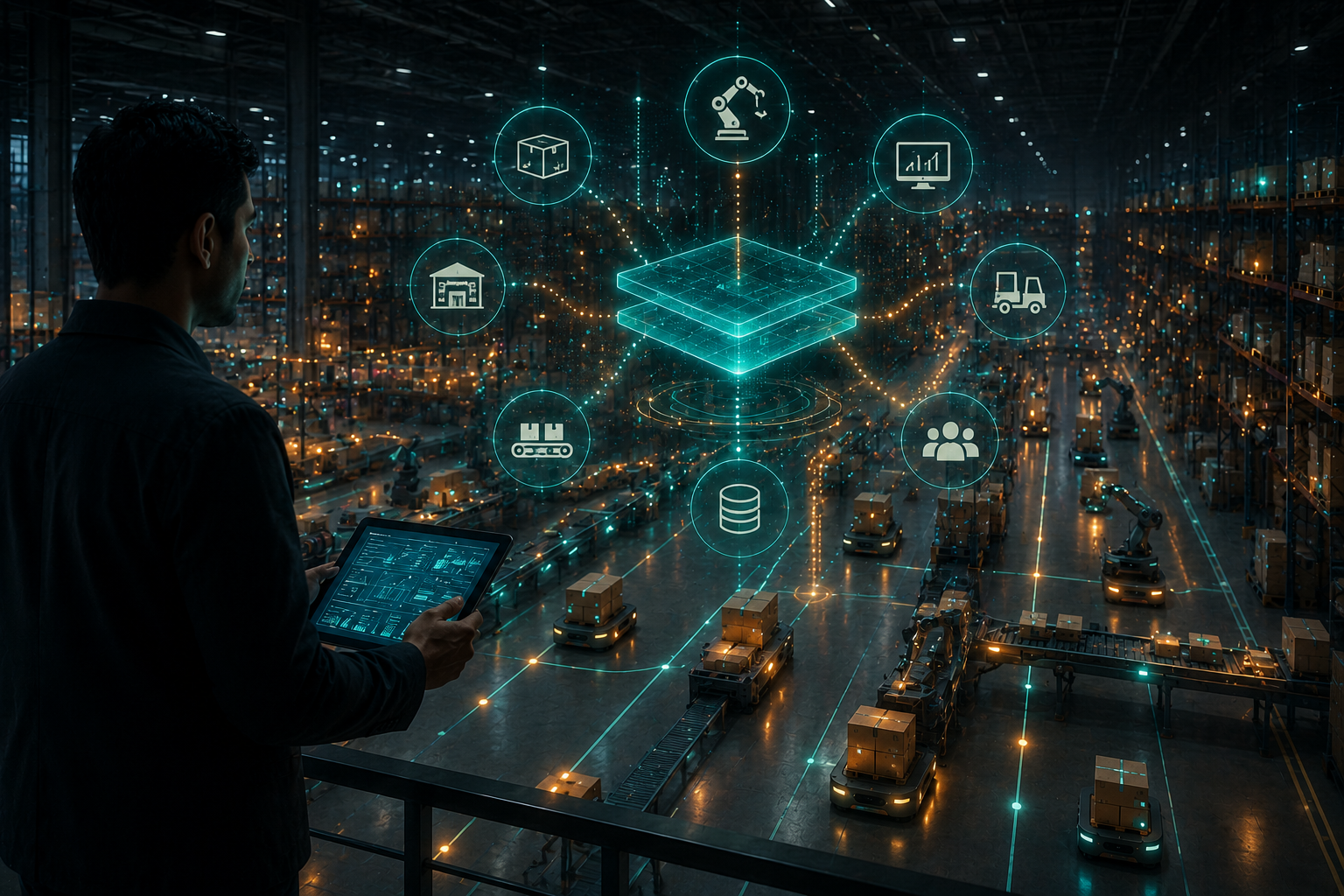
A warehouse orchestration system (WES) is the intelligence layer most Indian warehouses are missing—and the one most critical as automation investment grows across the country. Consider this scenario: you invested INR 5 crore in a conveyor automation system for your distribution centre. Throughput improved by twenty percent. The vendor had projected forty percent. Your team spent three months trying to optimise the system. The improvement plateau held at twenty-two percent. The vendor blamed your workforce. Your team blamed the vendor.
The real problem was neither. Your WMS was sending tasks to human pickers and automated systems through separate task queues, with no real-time coordination. Human pickers waited while conveyors were busy. Conveyors sat idle while pickers were in another zone. Nobody was orchestrating the interaction between the two. That orchestration layer—the layer that coordinates humans and machines in real time—is what a warehouse execution system provides.
Context: Indian FMCG and e-commerce warehouses are investing INR 2–15 crore in AMRs, conveyors, and sortation systems—PLI scheme capital availability and rising labour costs are accelerating adoption.
Most supply chain professionals understand WMS and WCS. WOS is the layer in between that most do not understand—and the one that most directly determines whether automation hardware delivers on its projected return.
SystemWhat It DoesAnalogyUpdate FrequencyWMSManages inventory, orders, and allocation — determines what needs to happen and whereThe General — sets strategy and objectivesMinutesWOSOrchestrates task execution across labour and automation in real time — determines how and when each task is executedThe Sergeant — coordinates resources on the groundSecondsWCSControls hardware directly — conveyors, sorters, AMRs execute the physical movementThe Private — executes specific commandsMilliseconds
Without WOS, the General issues orders and the Privates execute them—but nobody is coordinating who does what, when, and in what sequence. The result is the same inefficiency that occurs in any organisation without middle management: duplicated effort, idle resources, and breakdowns that nobody catches until they cascade.
1. Real-time task sequencing. WOS determines the optimal execution order for every task in the warehouse—picks, putaways, replenishments, counts—based on current conditions, not pre-planned schedules. If Zone A is congested, WOS routes the next task to Zone B. If Conveyor 3 is processing a batch, WOS holds the next batch until it clears. These decisions happen in seconds.
2. Load balancing across resources. WOS continuously monitors workload across zones, pickers, and automation equipment. When one zone is overloaded and another is ahead of schedule, WOS reallocates resources in real time—preventing the bottlenecks and idle time that destroy throughput.
3. Labour-automation coordination. This is the core WOS function that no other system provides. WOS knows which human pickers are available, which AMRs are free, and which conveyor lanes are clear—simultaneously. It assigns tasks to the optimal resource at any given moment, whether human or machine, based on proximity, capacity, and current utilisation.
4. Exception handling in real time. When a conveyor belt jams, an AMR hits an obstacle, or a zone runs out of stock, WOS reroutes affected tasks immediately—before the exception becomes a throughput collapse. Without WOS, exceptions cascade silently for minutes before a supervisor notices.
5. Continuous throughput optimisation. WOS does not execute a static plan. It continuously optimises based on live conditions—adjusting sequencing, routing, and resource allocation as the shift progresses. The warehouse at 2pm operates differently from the warehouse at 10am, and WOS adapts to both.
Indian enterprises are accelerating warehouse automation investment. PLI scheme capital, rising labour costs (warehouse worker wages have increased 15–20% over the last three years), and q-commerce SLA pressure are driving adoption of AMRs, conveyors, pick-to-light, and sortation systems.
But the pattern is consistent: automation hardware delivers sixty to seventy-five percent of its projected throughput improvement. The missing twenty-five to forty percent is not a hardware problem. It is an orchestration problem:
Separate task queues. WMS sends tasks to human pickers through one queue and to automation through another. Neither system knows the other’s current state. Human pickers wait for AMR delivery while the AMR is serving another zone. The conveyor runs empty while pickers are still walking.
Static task assignment. Without WOS, task assignment is rules-based and static: Zone A always goes to Picker 1; Zone B always goes to AMR 2. When Zone A has a surge and Zone B is quiet, the system cannot rebalance in real time. The result: one resource overloaded, another idle.
No exception coordination. When a conveyor line jams, the WMS continues assigning tasks to that line because it has no real-time awareness of equipment status. Tasks back up. Pickers wait. Throughput drops. By the time a supervisor physically walks to the jam, ten minutes of productivity are lost.
DimensionWMS Without WOSWMS With WESTask assignmentStatic, rules-basedDynamic, real-time optimisedResource awarenessKnows inventory locationsKnows every resource’s current stateUpdate frequencyMinutesSecondsBottleneck responseAfter the fact (reporting)Instant rerouting (prevention)Automation ROI60–75% of projected90–100% of projectedHuman-machine coordinationSeparate queuesUnified orchestration
WMS is essential. WOS does not replace it. But WMS without WOS in an automated warehouse is like a flight plan without air traffic control—you know where you want to go, but nobody is managing the real-time traffic.
WCS (warehouse control system) is sometimes confused with WOS, but they operate at different levels. WCS controls the hardware directly: it tells Conveyor 3 to run at speed X, tells AMR 7 to move to location Y, tells Sorter 2 to divert package Z to lane 4. WCS is machine language. WOS is the decision layer above WCS that determines which tasks go to which machines, in what sequence, coordinated with which human resources. WCS executes. WOS orchestrates.
Operations with AMRs, conveyors, sorters, or pick-to-light systems. High-volume multi-shift warehouses where human and automated workflows intersect. 3PL operations with multiple SLA clocks where task prioritisation across clients must happen in real time. Any warehouse experiencing automation ROI shortfall—the gap between projected and actual throughput improvement after automation deployment.
WOS embedded natively in Stackbox WMS. Not a separate system. Not an add-on. Not a third-party integration. The WOS layer runs within the same platform as WMS and WCS, using the same data model, with zero API lag, zero sync failures, and zero reconciliation overhead.
Dynamic interleaving. Stackbox’s WOS combines pick, putaway, and replenishment tasks into single efficient routes. A picker completing a pick in Zone A is immediately assigned a putaway task in the adjacent aisle, then a replenishment task on the return path—maximising productive movement and eliminating empty travel.
Hardware-agnostic. Stackbox’s WCS/WES layer works with AMRs, conveyors, sorters, and pick-to-light systems from any vendor. Indian enterprises that invest in automation from one vendor and WOS from another face integration costs of INR 50–150 lakh and timelines of 3–6 months. Stackbox’s native WOS eliminates this entirely.
Result: 2× throughput from automation hardware versus systems without native WOS—verified across Stackbox deployments in India. Stackbox is India’s number one hardware-agnostic, on-cloud WCS, embedded natively with WMS and WOS.
Future-proofing. As Indian enterprises add new automation equipment over time, Stackbox’s hardware-agnostic WCS/WOS layer integrates new hardware without WMS reconfiguration—protecting the core platform investment regardless of automation technology evolution.
Q: What is a warehouse orchestration system (WOS)?
A: WOS is the intelligence layer between WMS and WCS that orchestrates task execution across human labour and automation equipment in real time. It determines how and when each task is executed, balances workloads dynamically, and coordinates humans and machines to maximise throughput.
Q: Do I need WES if I already have a WMS?
A: If your warehouse uses any automation hardware (AMRs, conveyors, sorters, pick-to-light), yes. Without WOS, your WMS assigns tasks without real-time awareness of which resource is free—resulting in 15–25% underperformance on automation ROI.
Q: Is Stackbox’s WES a separate product requiring separate integration?
A: No. Stackbox’s WOS is embedded natively in the WMS—same platform, same data model, zero API lag. No separate system, no integration project, no extra licence cost.
Q: What is the ROI impact of WES on automation investment?
A: WOS is typically 10–15% of total automation investment but accounts for 30–40% of the throughput gain. Without WOS, Indian enterprises consistently achieve only 60–75% of projected automation throughput.
Q: Can Stackbox WOS work with automation hardware from any vendor?
A: Yes. Stackbox’s WCS/WOS layer is hardware-agnostic—it integrates with AMRs, conveyors, sorters, and pick-to-light systems from any manufacturer, eliminating vendor lock-in and the INR 50–150 lakh integration costs typical of multi-vendor environments.
See how Stackbox’s native WOS maximises your automation ROI without a separate system, a separate integration project, or vendor hardware lock-in. No commitment, 30-minute walkthrough.


