
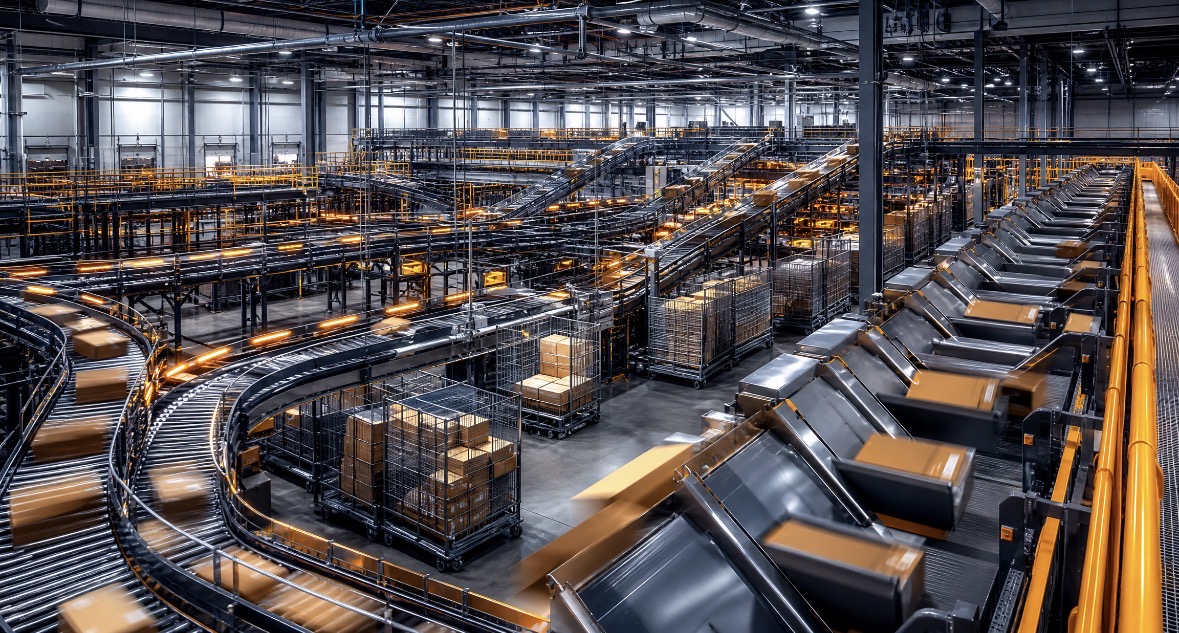
Many warehouse decisions involve a significant commitment before the impact is known. A layout reconfiguration, a new slotting strategy, or an automation investment each carries a cost of change that is hard to reverse once made, and testing the outcome in advance is difficult without a model.
Warehouse simulation helps here. By building a digital model of the warehouse and running scenarios against it, operations teams can estimate the impact of a change before implementing it and inform the decision with model data rather than intuition alone.
This article covers what warehouse simulation is, how it works, what it can and cannot tell you, and where it fits in the broader decision-making process.
Warehouse simulation is a digital model of a physical warehouse operation. The model captures the warehouse layout, product placement (slotting), order profiles, resource types (workers, equipment, automation), and movement logic. When a scenario is run against the model, the simulation calculates how the operation performs under those conditions: throughput rate, pick path lengths, zone congestion, resource utilisation, SLA attainment.
The simulation is fed by real operational data, actual order histories, actual SKU velocities, actual layout dimensions, so the scenarios are grounded in the operation's real demand patterns, not theoretical assumptions.
No simulation is a perfect replica of real operations. Warehouse simulation models the physical and logistical structure of the operation; it cannot fully model the variability introduced by human behaviour, equipment downtime, supplier delays, or unplanned demand spikes. Results from simulation are directional, they tell you the direction and approximate magnitude of a change's impact, not a guaranteed precise outcome.
Simulation is also not the only planning tool; it is most valuable when combined with operational judgment and, where possible, limited real-world pilots. For decisions where the stakes are high and model assumptions have significant uncertainty, piloting at small scale before full rollout remains the most reliable risk management approach.
A standalone simulation tool creates a model of the physical warehouse environment and runs throughput scenarios against it. Some tools specialise in this, Arena Simulation, Simio, and others are used for warehouse and DC design modelling. SAP offers planning and optimisation tools within its ecosystem, but SAP EWM slotting and SAP IBP address slotting recommendations and broader supply-chain planning respectively; neither is established here as equivalent to physical warehouse-flow simulation without confirming the exact function required.
Standalone simulation tools are often used at the design or redesign stage, but they are not limited to it: some platforms, such as Simio, integrate live operational data and support operational what-if scenarios. The more useful comparison is integration effort, model scope and who owns model maintenance, rather than a fixed design-time versus operational boundary. They typically require specialist input to build and validate the model.
The limitation of standalone simulation is that the model typically needs to be updated as the real warehouse changes, new SKUs, layout modifications, demand shifts. In a dynamic operation, the frequency of updates required depends on how quickly the operation changes and how the simulation is integrated with operational data sources.
Some Warehouse Orchestration Systems include simulation capabilities that are natively connected to live operational data. Because the WOS is already running the operation, maintaining the current layout, slotting, order queue, and resource state, integrated simulation can reuse that operational data and reduce duplicate setup. Model logic, assumptions, constraints and validation still need to be established and maintained.
This supports operational use: a manager can run a what-if scenario against today's order queue and today's layout to evaluate the impact of a specific change before making it. Integrated simulation reuses live operational data rather than requiring a separate data-build, though the model logic, assumptions and validation still need to be established and maintained. Some standalone tools also support operational scenarios; the practical differences are integration effort and maintenance ownership.
Stackbox WOS includes this type of integrated simulation capability.
Simulation is most directly applicable to layout and slotting decisions. Moving a high-velocity product closer to the dispatch area, changing the pick face allocation for seasonal products, reorganising zone boundaries, these changes have predictable effects on pick path length and throughput rate, and simulation quantifies them before implementation.
Before committing to AMR fleet expansion, ASRS installation, or sorter capacity addition, simulation can estimate the throughput impact of the investment under different demand scenarios. This is particularly valuable for capital-intensive decisions where the cost of a wrong choice is high.
Simulating peak demand scenarios against current operational configuration identifies constraints before they occur in real operations. A simulation run against last year's Diwali order volumes on this year's layout helps the planning team identify where bottlenecks are likely to occur under the modelled conditions, and gives time to address them before the peak arrives.
How many pickers does a shift need to hit a specific SLA target for a given order queue? Simulation can model this more accurately than linear extrapolation, particularly when the order queue has a complex mix of large and small orders across multiple zones.
As a hypothetical illustration: an operation that redesigns its slotting based on simulation output and runs quarterly scenario reviews could expect to see reductions in travel time and improvements in throughput attainment, the magnitude depends on the operation's starting point, SKU mix, and how consistently simulation insights are applied. Simulation outputs are directional guidance, not guaranteed results.
Simulation can be a standalone tool or embedded in a WOS. Standalone simulation tools (Arena, Simio, and others) are independent of the WMS and require a model to be built and maintained. Embedded simulation, as found in some WOS platforms, runs against live operational data from the WOS itself, which reduces duplicate setup; the model logic, assumptions and validation still need to be maintained. The right approach depends on whether you need design-time scenario modelling, operational what-if analysis, or both.
Accuracy depends on the quality of the underlying data and the sophistication of the model. Simulations built from real order histories and accurate layout data are more accurate than those built from assumed averages. All simulations have limitations: they model the physical and logistical structure of the operation but cannot fully capture the variability of human behaviour, equipment downtime, or external disruptions. Treat simulation outputs as directional guidance, not precise predictions.
Core inputs are: warehouse layout (dimensions, aisle structure, location addresses), SKU slotting (which products are in which locations), order history (actual orders processed over a representative period, ideally including peak), resource profile (workers by zone and shift, equipment types and speeds), and SLA targets. The richer and more accurate this data, the more reliable the simulation outputs.
Yes, this is one of the strongest use cases for simulation. Before committing to an AMR fleet expansion, ASRS installation, or sorter capacity addition, simulation can estimate the throughput impact under realistic demand scenarios. This is particularly valuable for capital-intensive decisions where the cost of an incorrect choice is significant. The simulation should be run across multiple demand scenarios, not just average demand, to capture peak and low-demand behaviour.
To discuss Stackbox WOS simulation capabilities and how they apply to your operation, visit stackbox.xyz/product/sbx-wms.


