
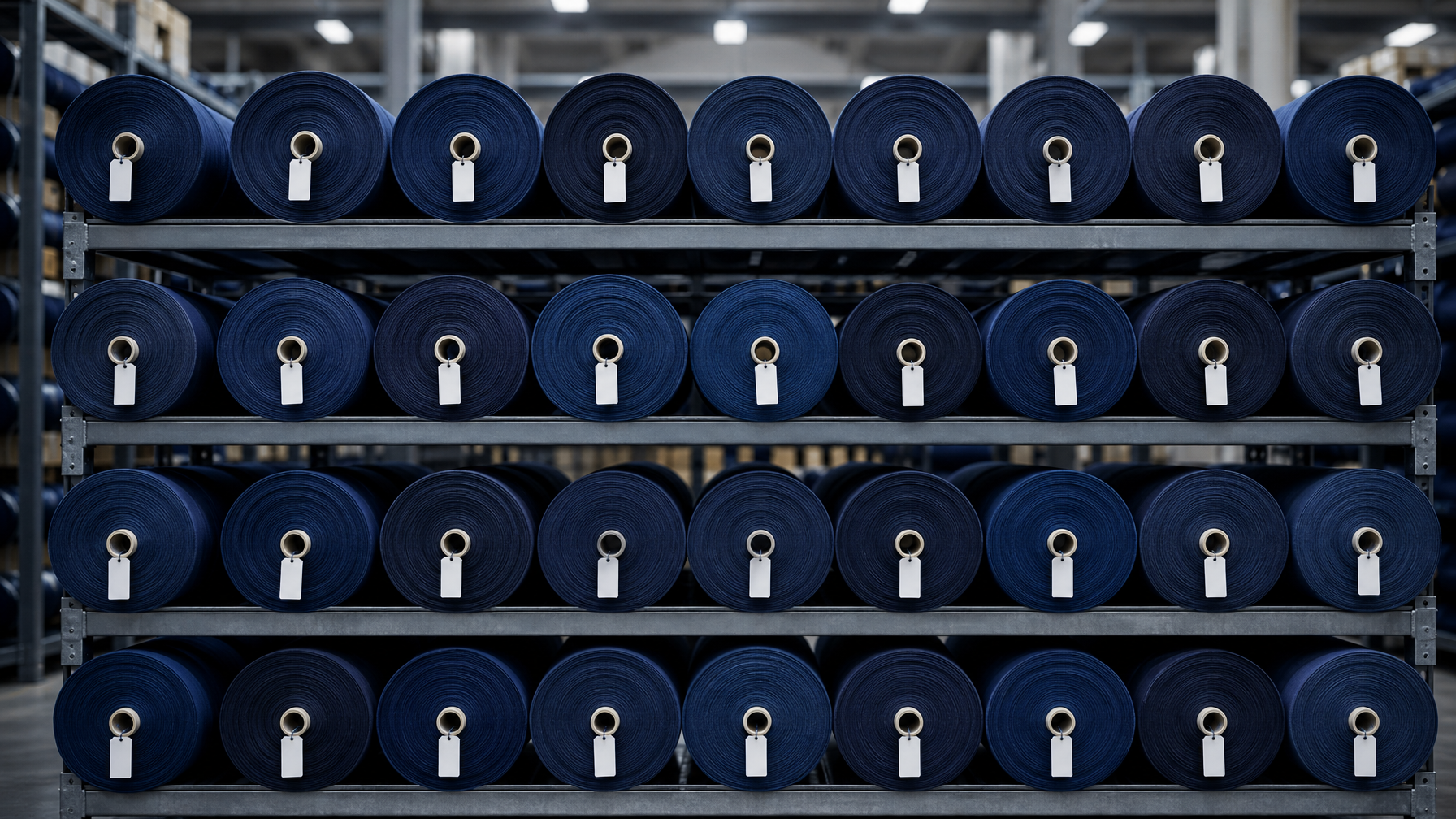
India exports over $40 billion of textiles a year. Behind that number sit some of the hardest warehouses to run in any supply chain. Textiles are not FMCG. You cannot swap one roll for another, even when the SKU code, colour name, and fabric are identical. Two rolls of the same navy cotton from the same mill, made a week apart, can look different side by side. This is the shade variation problem. It is why generic WMS software fails in textile warehousing.
A WMS for textile and yarn in India must understand lot-level identity. It must enforce shade-matched picking, track stock by the roll instead of the case, and handle weight-based and length-based units of measure together. Without these, you ship orders that the garment factory rejects for shade mismatch. That means returns, rework, and damaged supplier relationships.
Shade variation is built into dyed textiles. The final colour depends on water temperature, dye chemistry, processing time, humidity, and how the base fibre absorbs dye. Two runs of the same colour spec almost always come out slightly different. The industry tracks this with shade bands or shade cards, coded so each dye lot carries a unique identifier.
In a garment factory, every panel of a shirt must come from one shade band. A sleeve from band A-4 and a body from band A-7 will show a visible difference under store lighting. So the warehouse is not just shipping fabric. It is shipping shade-matched fabric, and the WMS must enforce that at the pick.
A standard WMS tracks stock by SKU, location, and quantity. It cannot tell two pallets of the same SKU apart if their shade codes differ. A picker gets an order for 200 metres of navy cotton and goes to the nearest location. That location holds shade A-4. The next holds A-7. The picker fills the order from both and never knows. The mismatch surfaces at the cutting table, 500 kilometres away.
Tag every incoming roll or bale with its shade code at receiving. The WMS then creates a lot record linking the shade code to the physical stock, its location, and the supplier's production batch. From that point, putaway, transfer, picking, and dispatch all respect the shade boundary.
When an order arrives, the WMS does not just check for 200 metres of navy cotton. It checks for 200 metres from the same shade band. If no single lot can fill the order, the system alerts the planner before picking starts. The planner can then split the order with the customer's approval or source matching stock.
Textiles do not ship in uniform cases. A roll can run from 30 to 120 metres depending on the fabric and the mill. Two rolls of the same SKU and shade band may differ in length. Partly used rolls, where some metres were already cut and shipped, add more variation.
A textile WMS tracks each roll on its own. Every roll carries an ID, length, weight, shade code, and quality grade. To fill an order, the system picks specific rolls that together meet the required metres, accounting for partial rolls and keeping waste low. This also supports accurate stock counts without measuring every roll by hand.
Yarn sells by weight in kilograms. Fabric sells by length in metres. Some products trade in both. A customer orders 500 metres, but the invoice is based on weight because the fabric is priced per kilogram. The WMS must handle dual units, convert between them using GSM (grams per square metre) or linear density, and stay accurate as rolls are partly consumed.
| Product Type | Primary UOM | Secondary UOM | Tracking Level | Key Attribute |
|---|---|---|---|---|
| Woven Fabric | Metres | Kilograms | Roll | Shade band, width, GSM |
| Knitted Fabric | Kilograms | Metres | Roll | Shade band, stretch % |
| Yarn (Cone) | Kilograms | Count/Nm | Cone/Lot | Shade, twist, ply |
| Yarn (Hank) | Kilograms | Count | Bale/Lot | Shade, fibre blend |
| Denim | Metres | Kilograms | Roll | Shade, oz weight, width |
Lot-locked picking is the most important workflow in textile warehousing. Most garment orders specify a single shade. So the WMS must limit the pick to one shade lot. If that lot falls short, the system must not quietly fill the gap from another.
Before it releases a pick list, the WMS runs a shade availability check. It compares the order quantity against each shade lot, picks the best fit (leaving the fewest remnants and partial rolls), and locks the pick list to that lot. If no single lot can fill the order, the planner gets three options: ship part of the order from one lot, split across two lots with customer approval, or back-order until matching stock arrives.
Without lot-locked picking, textile warehouses see 3-8% of shipped orders rejected for shade mismatch. With fabric orders worth INR 2-5 lakh on average, even a 5% rejection rate costs crores a year in returns, reprocessing, and strained customer relationships.
Textiles are inspected at several stages. At the warehouse, incoming rolls are graded by defect density, usually with a four-point system. Grade A (first quality) goes into main stock. Grade B (second quality, minor defects) can go to a separate pool for discount channels. Rejected rolls are quarantined and returned to the supplier.
The WMS must hold quality grade as a stock attribute alongside shade and lot. A request for first-quality fabric must never pull from the seconds pool, even when SKU and shade match. In textiles, one SKU can exist in many states: by shade, by grade, by how much has been used. That multi-attribute model is what makes textile warehousing different from standard distribution.
Textile warehouses in India have physical traits the WMS must respect. Rolls are heavy. A single denim roll can weigh 30-50 kilograms and needs racking built for horizontal or vertical roll storage. Yarn warehouses often use deep-stack pallet storage for bales, with tight aisle access that limits picking flexibility.
Humidity control matters for natural fibres. Cotton absorbs moisture from the air. Too much humidity causes mildew, weight gain (which distorts weight-based pricing), and fibre damage. The WMS should track conditions in storage zones and flag stock held beyond its humidity tolerance.
Fire safety is the third factor. Textile warehouses carry a high fire load, and National Building Code requirements often cap storage density. The WMS enforces those caps by blocking over-stocking in fire-rated zones and keeping access to fire suppression clear.
Stackbox is a cloud-native WMS trusted by 9 of India's top 10 consumer products companies. It runs across 2,500+ distribution points in 16+ countries. Its core deployment is FMCG and CPG, but its lot-level tracking architecture supports the attribute-rich inventory that textiles demand.
Stackbox delivers lot-level shade tracking from receiving to dispatch. It manages roll-level inventory with dual UOM support. It runs lot-locked picking that prevents shade mismatches, and it segregates stock by quality grade. It gives multi-warehouse visibility across production warehouses, distribution centres, and regional hubs. And it offers prebuilt connectors for the SAP and Oracle ERPs common in India's textile industry.
The platform delivers 99.9% inventory accuracy across its deployments. In textiles, where one roll mismatch can cascade into order rejections and production delays, that number matters.
Textile warehousing needs lot-level shade tracking, roll-level inventory (each unit has its own length and weight), dual units of measure (metres and kilograms), quality grade segregation, and shade-locked picking to prevent colour mismatches in garment production. FMCG warehouses handle uniform cases and cartons whose units are interchangeable.
Two rolls of the same colour and fabric can look different because they came from different dye lots. If a warehouse ships mixed shade lots in one order, the garment maker cannot use them together. The rejections, returns, and recuts cost 3-8% of annual revenue in textile distribution.
No. A standard WMS tracks stock by SKU and location. It cannot enforce shade-locked picking, track rolls of varying length, convert dual UOM, or segregate quality grades. Textile operations need a WMS with native multi-attribute lot management.
Each roll gets a unique ID at receiving, tagged with length, weight, shade code, quality grade, and supplier lot. The WMS tracks use as partial rolls are picked, updates remaining length in real time, and chooses the best roll combinations for each order to keep waste and remnants low.
Prioritise shade-lot matching (international rejections cost far more), roll-level tracking with dual UOM, quality grade workflows, humidity and environmental monitoring, multi-warehouse visibility across production and export hubs, and compliance documentation for international quality standards.


