
From enterprise orchestration ceiling to autonomous supply chain at national scale.
The client is a Fortune Top 50 FMCG company. The name is withheld under NDA. The 40%, >90%, and 100% figures are outcomes reported by the client across the 29 Indian DC deployment. The specific measurement period and baseline conditions are not publicly disclosed. The 55-site global rollout was in active pipeline at the time of this case study.
| 40% | >90% | 100% | 29 DCs |
|---|---|---|---|
| Travel Distance Reduction | Work Availability | System-Guided Operations | Live, 55 in pipeline |
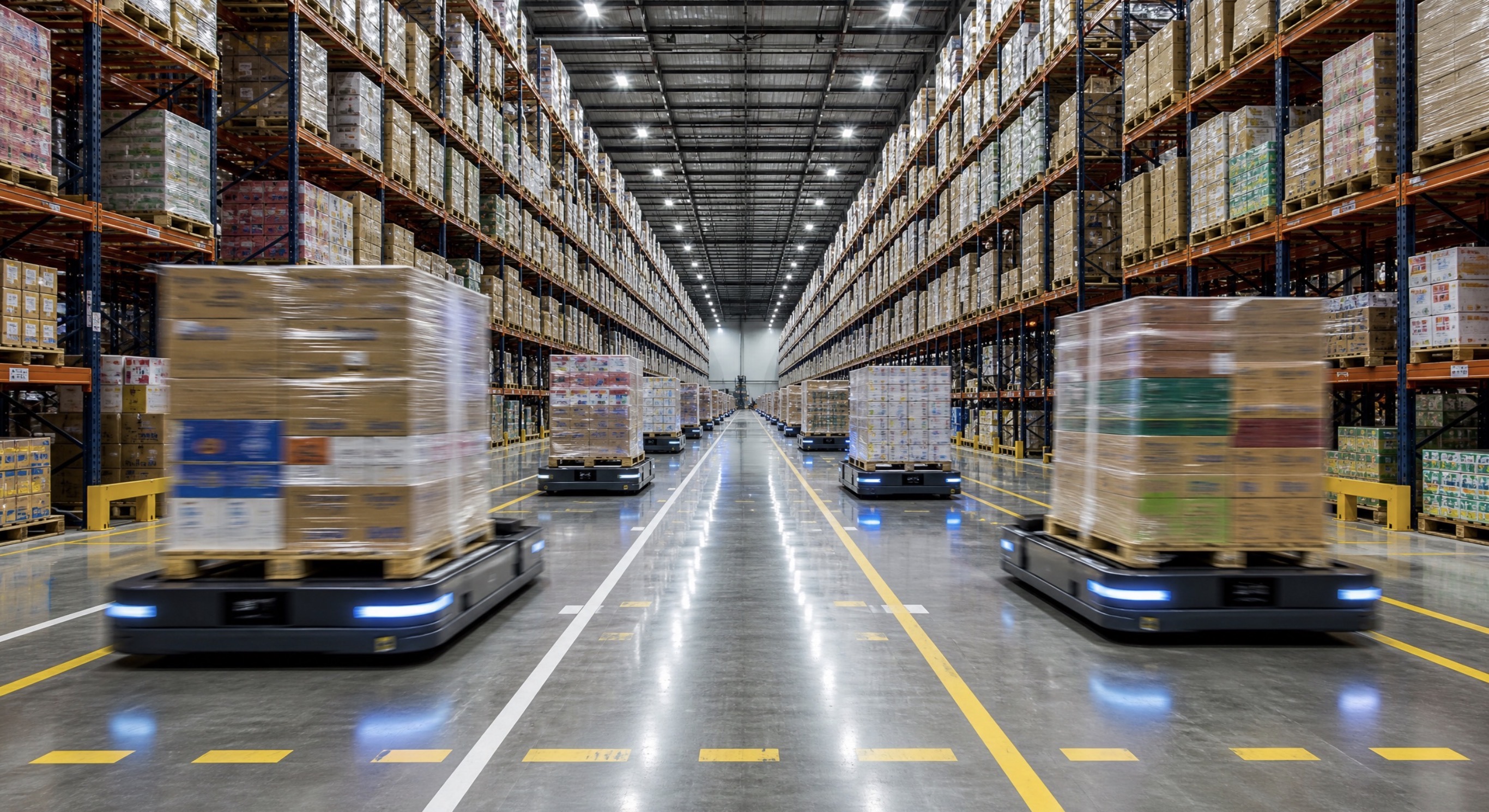
A Fortune Top 50 FMCG company, one of the world's largest consumer goods manufacturers, operating mega distribution centres across India with facilities running up to 270,000 square feet and 20,000 pallet positions per site.
Each DC manages multi-temperature zones, dry, ambient, and hazardous, alongside taint constraints, mixed human-AMR fleets, and order SLA profiles ranging from 4 hours to 48 hours. At this scale, operational complexity grows exponentially with each variable added.
Before Stackbox, the network faced what the client's team called the Enterprise Orchestration Ceiling: the point at which the complexity of the operation outgrows the tools available to manage it. Three problems defined that ceiling.
Fleet Fragmentation. Pallet AMRs and human-operated forklifts shared zones without a unified task engine to coordinate them. Each operated on separate logic with no shared real-time visibility. The result was zone congestion, resource underutilisation, and work stoppages.
SLA Complexity. 4-hour and 48-hour SLA orders ran simultaneously across the same facility. Static wave planning assigns work in batches and cannot reprioritise a 4-hour order once it is in the same wave as a 48-hour order. Real-time prioritisation was operationally necessary and technically unavailable.
Supervision Gap. Manual oversight across multiple shifts, temperature zones, and 29 sites could not scale. Work availability dropped when supervisors were stretched. Exceptions were identified after they had already impacted throughput.
The problem was not effort. Supervisors and operators were skilled. The problem was that the tools were designed for simpler operations. At this scale, autonomous orchestration replaces what manual supervision cannot sustain.
Stackbox deployed its full WMS and WES stack as the central orchestration layer, co-engineered with the client's operational teams. The deployment integrated with the client's existing SAP EWM environment: SAP EWM managed order lifecycle, Stackbox WES managed physical execution including GTP-based packing, QC, and transporter-level sorting.
The core element was the Stackbox SBX Multi-Agent Orchestrator: an AI-driven coordination layer governing movement, prioritisation, and task allocation across mixed human-AMR environments as a single unified system.
| Solution pillar | What it did |
|---|---|
| Unified WMS and WES | End-to-end management of inbound receiving, multi-leg putaway, FEFO inventory control, and all outbound flows across full pallet, case, and eaches with batch-to-customer-level segregation |
| Multi-Agent Orchestrator | Real-time traffic management, dynamic task allocation, and congestion prevention across mixed human-AMR zones; continuous SLA-based prioritisation; zero manual intervention required for routine task assignment |
| SAP EWM integration | SAP EWM managed order lifecycle; Stackbox WES owned picking execution, GTP-based packing, QC, and transporter-level sorting |
The following outcomes were reported by the client across the 29 Indian DC deployment. Measurement period and baseline conditions are not publicly disclosed. The 55-site global rollout was in active pipeline at the time of this case study.
| Outcome | What it means operationally |
|---|---|
| 40% travel distance reduction | Achieved through intelligent task interleaving and AMR route optimisation. The orchestrator continuously recalculates routes based on current zone occupancy rather than batch plans set at the start of a shift. |
| >90% work availability | Maintained consistently across all shifts and temperature zones. Workers receive task assignments from the system continuously rather than waiting for supervisor direction. |
| 100% system-guided operations | Task allocation and execution decisions require no manual intervention under normal operating conditions. Supervisors focus on exceptions and continuous improvement. |
| 29 DCs live in India | 55 global sites in active rollout pipeline as of the case study date. |
Enterprise-scale FMCG distribution at this complexity level requires more than integrated software. An ERP warehouse module cannot manage mixed-fleet orchestration in real time. Static wave planning cannot handle simultaneous 4-hour and 48-hour SLA profiles. Manual supervision cannot maintain consistent work availability across 29 facilities on multiple shifts.
The deployment demonstrates that these problems are solvable at scale when the WMS architecture is purpose-built for the complexity: multi-agent orchestration, autonomous task allocation, and real-time SLA prioritisation operating as the core model rather than as supplementary features.
Why is the client name not mentioned in this case study?
The client's identity is withheld under a non-disclosure agreement. The operational details, deployment scope, and results figures are drawn from the Stackbox FMCG case study document (2026) and reflect the actual deployment.
Did Stackbox replace SAP EWM in this deployment?
No. SAP EWM continued to manage order lifecycle. Stackbox WES handled physical warehouse execution, picking, GTP-based packing, QC, and transporter-level sorting. The two systems ran in parallel, each covering its strongest domain, with a clean integration between them.
What does 'system-guided operations' mean in practice?
It means that task allocation and execution decisions, which worker picks which order, which AMR goes to which zone, how competing SLAs are prioritised, are made by the system in real time without requiring a supervisor to intervene. Under normal operating conditions, supervisors focus on exception management rather than routine task assignment.
How does the Multi-Agent Orchestrator handle AMRs and humans in the same zone?
The orchestrator maintains a real-time model of the warehouse state, including the location and status of every AMR and every human worker. Task assignments are made based on current zone occupancy, resource availability, and order SLA priority. This prevents congestion, reduces idle time, and ensures that the highest-priority work is always assigned to the nearest available resource.
Is this deployment model replicable for smaller FMCG operations?
The core architecture, unified WMS and WES, multi-agent orchestration, FEFO enforcement, SAP integration, is available across Stackbox deployments regardless of scale. The specific complexity of 270,000 sq ft DCs with mixed AMR fleets and 4-to-48-hour SLA profiles is at the upper end. Stackbox deployments range from single regional DCs to national networks. The right starting point depends on the operation's specific complexity and automation level.
The orchestration layer behind this deployment is explained in our guide to the warehouse orchestration system, and the AI coordination model in our AI maturity framework. For the platform behind it, see the Stackbox vs SAP EWM vs Infor comparison.
To discuss how Stackbox WMS handles multi-site FMCG operations at scale, request a scoped conversation with the Stackbox solutions team at stackbox.xyz.


