
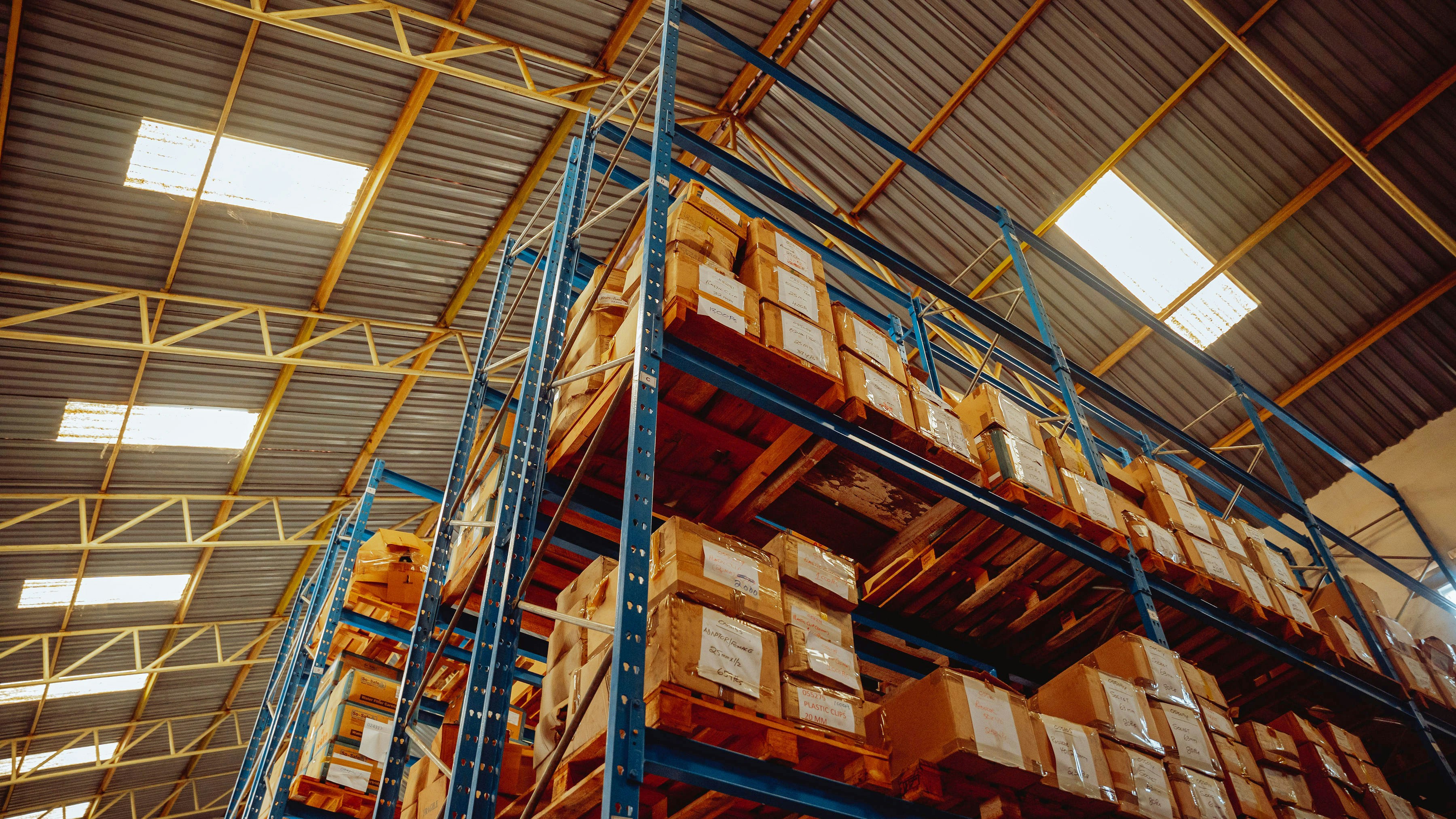
A Warehouse Orchestration System (WOS) is the real-time intelligence layer that sits above your WMS, your WCS, and your physical equipment as the brain. It continuously coordinates every operator, every machine, every dock, and every storage location as one adapting system. Traditional warehouse software operates in silos: WMS records inventory, WCS directs individual machines, ERPs sit further upstream. WOS is the only layer that connects all of them and turns recording into deciding, in real time.
You can build the most sophisticated planning system in the world. You can forecast demand to the hour. But if your warehouse cannot orchestrate itself in real time, if it cannot match the right operator to the right MHE, move the right pallet to the right dock, and sequence a thousand tasks without missing a single cut-off, then none of that planning translates to execution.
This is the gap that exists in every mechanised distribution centre running a WMS without an orchestration layer. The WMS knows where inventory is. The WCS controls conveyor speed and AMR routing. But no system is coordinating the interaction between human operators, material handling equipment, dock schedules, battery cycles, aisle availability, and carrier cut-off deadlines simultaneously. Supervisors fill this gap with radios, whiteboards, and years of experience. It works until scale, speed, or complexity exceeds what human coordination can manage.
WOS fills that gap. It answers five questions, continuously, simultaneously, and in real time:
| # | The Question WOS Answers Every Second | What It Means in Practice |
|---|---|---|
| 01 | What needs to be done right now? | Pending putaway, pick, replenishment, and transfer tasks ranked by urgency, order priority, and carrier deadlines |
| 02 | How should it be done? | One-step vs multi-step execution, which type of resource is most optimal given constraints and costs |
| 03 | Who should do it: operator or MHE? | Operator certification, current MHE location, battery level, and workload balance evaluated in under a second |
| 04 | In what sequence? | Task order optimised by aisle path, pick face proximity, dock priority, and SLA deadlines to minimise travel and maximise throughput |
| 05 | How does the plan adapt when conditions change? | MHE breakdowns, aisle congestion, battery alerts, pick starvation, or order priority changes trigger automatic rebalancing |
Source: Stackbox WOS Framework. From Chaos to Choreography, 2026.
The most common misunderstanding about warehouse orchestration is that it is an upgraded WMS. It is not. WMS and WOS operate at different layers of the warehouse technology stack, with different update frequencies, different awareness levels, and fundamentally different purposes.
| Dimension | Traditional WMS | Warehouse Orchestration System (WOS) |
|---|---|---|
| Core function | Records inventory and transactions | Decides what should happen next, in real time |
| Update frequency | Minutes | Seconds |
| Awareness | Knows where inventory is | Knows where every operator, every MHE, and every task is right now |
| Task assignment | Supervisor assigns to operator | System pushes optimised task to operator (push-based, constraint-aware) |
| MHE coordination | Rarely considers MHE type | Every task matched to required MHE capability, certification, and battery state |
| Task sequencing | FIFO or static priority rules | Dynamic sequencing by aisle, level, urgency, and travel distance |
| Task interleaving | None or basic same-zone pairing | Combines putaway, picking, and replenishment in a single MHE trip |
| Aisle traffic management | No conflict control | Virtual aisle locking prevents simultaneous MHE conflicts before they occur |
| Battery management | Operator-managed | System-triggered charging rotations based on real-time state-of-charge |
| Exception handling | Manual supervisor intervention | Automatic detection, impact calculation, and reallocation in real time |
The distinction matters because most WMS platforms include some form of task management. They generate pick lists. They assign tasks to operators. They record completions. But task management is transaction processing. Orchestration is decision-making. The difference is between a system that records what happened and a system that decides what should happen next.
| Layer | System | Function | Analogy |
|---|---|---|---|
| Strategy and Planning | ERP/OMS | Enterprise data, order flow, demand signals | The Board of Directors |
| Intelligence and Orchestration | WOS (Stackbox) | Real-time coordination of every resource, every second | The Operations Brain |
| Recording and Transactions | WMS | Inventory positions, order records, movement logs | The Ledger |
| Equipment Control | WCS | Direct machine commands: conveyor speed, AMR routing, sorter diversion | The Machine Controller |
| Physical Execution | MHE plus Operators | Reach trucks, stackers, BOPTs, HOPTs, human operators | The Workforce |
WOS does not replace WMS. It does not replace WCS. It sits between them and above them, connecting every layer into a single coordinated operation. Without WOS, each layer operates independently: the WMS generates tasks, the WCS controls machines, and nobody coordinates the interaction between them. If the acronyms above are still blurring together, our breakdown of how WMS, ERP and TMS divide the work maps the upper layers of this stack. With WOS, every task passes through an intelligence layer that evaluates constraints, assigns the optimal resource, sequences for minimum travel, and rebalances the plan when conditions change.
Every un-orchestrated mechanised warehouse experiences the same seven failures. They are not individual mistakes. They are system failures caused by the absence of a single intelligence coordinating every resource.
MHE type mismatch. Reach Trucks deployed to ground-level tasks that BOPTs could handle. High-value equipment wasted on low-complexity work, while high-bay tasks queue behind. 15 to 20 percent of Reach Truck travel wasted.
Aisle deadlocks. Two Reach Trucks enter a narrow aisle from opposite ends. One reverses the full length. 10 to 15 minutes of lost productive time per incident, occurring 5 to 15 times per shift in every un-orchestrated DC.
Pick starvation. Pickers arrive at empty locations because replenishment was not triggered in advance. Operators stall, skip locations, or call supervisors on radio. 5 to 15 incidents per shift.
Battery depletion at peak. A Reach Truck battery dies during the busiest hour. Charging was not planned. The machine blocks a narrow aisle. One event triggers a cascade that costs 30 to 45 minutes of disruption.
Dock coordination failures. An inbound trailer arrives and no BOPTs are positioned. The supervisor spends 20 minutes on radio reallocating resources that should have been pre-staged.
Outbound cut-off misses. At 15:30, the outbound team realises a 16:00 carrier order is not picked. Resources were committed to putaway because nobody was tracking cut-off progress against pick completion.
Invisible performance. At shift end, the supervisor cannot answer: how much empty travel did each Reach Truck log? Which aisles had the most conflicts? Which pick faces caused starvation? Without data, every improvement attempt is a guess. This is the same blind spot a warehouse control tower is built to close.
| Metric | Before WOS | After Stackbox WOS | Improvement |
|---|---|---|---|
| Throughput (picks and moves per shift) | Baseline | 1.25x baseline | +25% |
| MHE utilisation | 45 to 60% | 80 to 90% | +30% |
| Empty travel (non-value MHE movement) | 35 to 50% of trips | 15 to 20% | -30% |
| On-time dispatch | 85 to 92% | 96 to 99% | +14% |
| Dock-to-stock time | 4 to 8 hours | 2 to 4 hours | -50% |
| Aisle conflicts | 5 to 15 per shift | Zero | Eliminated |
| Mid-shift battery failures | 3 to 8 per shift | Less than 0.5 | -90% |
| Pick starvation incidents | 5 to 15 per shift | Near zero | -90% |
Source: Stackbox WOS deployment data across mechanised DCs. From Chaos to Choreography, 2026.
Prioritisation before assignment. Every task carries a priority score calculated dynamically from SLA urgency, order type, customer tier, and operational criticality. Before any task is assigned, the priority queue is re-sorted. The highest-priority eligible task is always assigned first, regardless of arrival order.
Constraint-aware matching. Assignment never happens without checking constraints. MHE certification is verified for every task-operator pairing. Aisle availability is checked before any Reach Truck is directed into a narrow aisle. Battery state-of-charge is evaluated before a high-duration task is given to a low-battery machine. Every assignment is executable before it is sent.
Continuous re-optimisation. Every task completion, every exception raised, every MHE status change, and every new order released triggers a re-evaluation of the task queue. Operators always receive the most current optimal task, not the task that was optimal twenty minutes ago when conditions were different.
Exception to resolution in minutes. When something goes wrong, WOS detects it immediately, calculates the operational impact, determines the optimal corrective action, and surfaces it to the supervisor. Resolution time drops from 30 to 60 minutes (manual discovery) to under 5 minutes (system-detected and resolved), per Stackbox deployment data. The full capability set is documented on the SBX WOS product page.
WOS is built for mechanised distribution centres where Reach Trucks, ASRS, Stackers, BOPTs, and HOPTs operate across multi-level racking structures alongside human operators. If your warehouse has ten or more MHE units operating simultaneously, multi-tier racking, and multiple inbound and outbound dock windows per shift, you are operating in the complexity zone where orchestration delivers compound returns. Before committing, warehouse simulation lets you test what orchestration would change in your specific layout.
Per Stackbox, the platform is running in live production, not pilots, across operations serving over 600,000 stores in 16 countries, including deployments with seven of the world's top ten CPG companies and nine of India's top ten by revenue. For the local picture — labour costs, automation maturity, and where Indian DCs sit on this curve — see warehouse orchestration in India.
What is a Warehouse Orchestration System (WOS)?
A Warehouse Orchestration System is the real-time intelligence layer that sits above WMS and WCS, continuously coordinating every operator, every machine, every dock, and every storage location as one adapting system. It decides what should happen next, who should do it, and in what sequence, then adapts the plan when conditions change.
How is WOS different from WMS?
WMS records inventory and transactions. WOS makes real-time decisions. WMS updates in minutes; WOS updates in seconds. WMS knows where inventory is; WOS knows where every operator and every MHE is right now. WMS generates task lists; WOS pushes the optimal task to the optimal resource with constraint-aware matching.
Does WOS replace WMS?
No. WOS does not replace WMS or WCS. It sits between and above them, connecting every layer into a single coordinated operation. WMS continues to manage inventory records. WCS continues to control equipment. WOS orchestrates the interaction between them in real time.
Who uses Stackbox WOS?
Per Stackbox, the platform runs in live production across 600,000-plus stores in 16 countries, with deployments at seven of the world's top ten CPG companies and nine of India's top ten.
What results does WOS deliver?
Per Stackbox deployment data, WOS delivers 25 percent higher throughput, 30 percent improvement in MHE utilisation, 30 percent reduction in empty travel, 14 percent improvement in on-time dispatch, and 50 percent reduction in dock-to-stock time.
To understand the platform layer WOS orchestrates from, see our 2026 ranking of the best WMS software in India. For the financial case, warehouse automation ranked by ROI explains why orchestration tops every payback list, and our guide to 15 warehouse KPIs covers the metrics orchestration moves.
➡ See Stackbox WOS in action at stackbox.xyz/contact
References: Stackbox WOS Framework. From Chaos to Choreography, 2026. Stackbox Deployment Data.


